“It’s not about the actual quilts, you know…”

Last weekend, I took a visit to my local Barnes and Noble. My boyfriend (technically, he’s my fiance, but I hate that word, so let’s agree here and now to use it as little as possible) was looking for a new book, and I find wandering the aisles of Barnes and Noble immensely relaxing so I tagged along. As I wandered around, I found myself in the Arts and Crafts section. Lately, I’ve been attracted to the idea of getting more into crafting, mainly because I’m constantly in my own head because my job/studies is all mental. I want to use my hands more. I think it’s a common desire among writers, and I’ve had this conversation with my classmates. In fact, two of my friends at school and I are planning on making soap together soon, so that should be fun. I’ll keep you posted.

Anyhow. So there I am, looking at the books on knitting and scrapbooking thinking about how these aren’t the right crafts for me, when I looked down a shelf and saw books on quilting. Immediately, I felt drawn to the books. It could be because it had been damn COLD that week, and we have a faulty window that won’t shut, so blankets have been top of mind.

Whatever it was,  I no idea why I immediately wanted to google quilting classes in my neighborhood. But later that night I was telling Laura about how I felt drawn to quilting, and how I couldn’t really understand the desire, since I’ve never really given much of a passing thought to this activity. (With the exception of that movie, “How to Make an American Quilt,” which I actually don’t remember anything about except there was a hot dude and old ladies sitting around quilting).

Laura then proceeds to hit the nail on the head. It’s not about the quilting, she tells me. It’s about the women you’re quilting with. And ding! That was it. Quilting is a group activity, at least from what I’ve heard. You sit around with a group of women and you quilt and talk. Not to be corny, but there’s a lot of power in a group of women coming together.

I realized that’s what I was missing in my life. A connected group of women to talk with. I have friends here now, and amazing friends around the country, which I am so immensely thankful for, but I do miss having a solid group of local girlfriends to talk with. There’s something very rich about the group dynamic. I think if you don’t have children, it’s hard to create a solid group of female friends in your 30’s.

If you’re reading this and thinking, “But I totally do!” then count yourself grateful and lucky.

So now the goal is to learn quilting, but also to cultivate relationships and try to bring the women in my life together.

FB-promo-quilt

Bad Mood Relief with Meditation and Therapy

While I love winters for the hot toddies and for having a legit excuse to wear tights and chunky sweaters (and mind you, I still do this in LA!)  it does mean our days are getting darker earlier and we’re getting less sunlight. Our bodies begin to lack that essential mood boosting Vitamin D. I’ve been fighting the blues this past year, on and off, so I can’t say it’s a “winter” thing or SAD (Seasonal Affective Disorder). Most of my blues is from the ongoing transition from moving from NYC to LA, and grad school stress. While my favorite self-soothing remedies help (a glass of wine, pizza, and an episode of Parenthood. Clearly, I’m also a cheap date) temporarily, I’ve found some lasting change in two practices. Meditation and Therapy. I’d like to tell you a little more about how they worked for me.

Meditation 

Have you tried meditation? I’ve always wanted to, and have some meditations sporadically over the years, but I’ve only recently gotten more serious about keeping the habit.

There are lots of ways to do it. You can simply sit still and concentrate on your breathing for a specified amount of time, 5-20 minutes generally. Or you can try a guided meditation using links online. I know Laura likes using guided meditations, and I find them useful too. I’ve found that when I have nothing to listen to, it’s so hard to sit still for more than 5 solid minutes.

Right now, I’m participating in the Oprah and Deepak Chopra “The Energy of Attraction” 21-day challenge. There’s still time to sign up. It’s a free series of 20 minute meditations for 21 days Check it out here. https://chopracentermeditation.com/about-us

I put a little candle on and let Deepak and Oprah do the work.

Meditating

Post meditating

There are also specific types of meditation. Two years ago, my friend and I checked into Transcendental Meditation, which lots of people SWEAR by, but despite the organization being a non-profit, there’s a steep fee for the introductory course, which I think is about $750. There’s a 50% discount for students, and I considered doing it in LA, but ended up deciding to wait until I had some more funds. We enjoyed the free Q and A we attended, and I really believe they are doing great work but damn if I can’t see paying that much for meditation. The thing that makes TM meditation somewhat different is that you’re assigned a mantra. (Always reminds me of Annie Hall, “Help! I’ve lost my Mantra.”)

Therapy 

I’m a therapy evangelist! I went for the first time about 6 years ago when I was going through a bad breakup. It was very helpful, especially when my therapist had me join a group session for people going through breakups. It was such a relief to talk to people going through the same thing. Luckily, it was covered by my health insurance with a co-pay. I think the co-pay was quite high, something like $40, but it still felt like a good deal at the time.

Now I’m in therapy once-a-week for regular talking sessions. Normally I just talk about the week and how it’s going. There’s no agenda, other than to release my thoughts. I’ve noticed that every time I leave therapy, I start yawning like a mad person on the bus ride home. Once I noticed this pattern, I realized how much I was holding in during the week, and how relaxing it was to get my mind unburdened.

Think money is an issue? Or do you not have health insurance? Sliding scale therapy is offered by a lot of psychological training programs. That’s what I do, and it’s based on what I can pay according to my salary. Since I’m in grad school and only work part-time, it was agreed upon that I pay $20 a session. That’s not bad at all! My therapist is technically a recent grad, but he’s pretty damn good.

And, ultimately, with therapists, it’s ALL about the fit. You have to feel like your therapist is right for you. Don’t be afraid to choose another therapist. It’s all about finding the right fit and approach.

So those are just two of my favorite healing techniques. But with both of them, the results are subtle and incremental over time. And yeah,  some days, the best therapy is a glass of wine and a good phone chat with an old friend.

Would you be friends with your mom if you were the same age?

How beautiful is this photo series by photographer Danielle Delph?

http://danielledelph.com/If-I-Had-Known-My-Mother-Back-Then

In a nutshell, this photographer took old photos of her mother at her age and photoshopped herself in, so it looks like her and her mother are hanging out together. It’s really sweet and touching.

I’d like to think I’d be friends with my mom if we met in different circumstances and were the same age. And even if we weren’t the same age, I’d like to think we’d still be friends. (FYI, I’m fascinated by friendship between women of vastly different ages, so if you’ve got  a story, please share with me.)

This photo series made me think about how I’ve discovered my parents personalities in deeper ways in the past 5-7 years and how even people closest to us can maintain a sense of mystery. I think when parents retire, a shift from obligation to personal exploration seems to happen for them. With my own parents, they both began to try new opportunities and almost gained a kind of youthful curiosity about certain things. It was exciting to see, and almost somewhat scary. Sometimes you think of your parents are immutable beings, steadfast and fixed in your memory and consciousness.

Accepting that my parents are growing just like I am is a beautiful thing. I’m learning about my parents as human beings, in much the same way new parents get to know their babies as they grow up into toddlers with their own distinct personalities.

Friendships and good ol’ phone calls

How do you communicate with your friends? Are you more of an emailer, texter, or caller? How do you maintain your relationships? For me personally, it’s a mix of all of the above. But I realized that I don’t talk on the phone at length with my newer friends, and by newer friends, I mean friends made in the last 5-10 years. I generally use emails, texts and social media to communicate with them.

I started thinking about this after reading the article, Is Voicemail Over? One interesting statistic from the article was a study from 2012 that said people use their phones for actual calls only 12 minutes a day.

Most of the people I talk to on the phone I’ve known for a really long time, and we grew our friendships by speaking on the phone, so it’s normal to continue that habit, and there’s something quite comforting about it. I remember that new, fresh period of my high school friendships when a friend and I would begin talking on the phone, and how intimate it felt, even though it was just two voices, laughing and chatting. Usually it involved me sitting on the rolling office chair in my room, attempting not to lean back too far, staring out the window at the adjacent apartment, gossiping about the Backstreet Boys, and being interrupted by my dad yelling, “Get off the phone or you’re not going to that Hanson concert!” (Oh god, did I really just admit that to the world? Yes.)

My phone doesn’t ring often. The only friends I talk to on the phone are older friends. I think somehow the phone as calling and talking device hasn’t gotten a bad rap – people see the a ringing phone as an intrusion. Nowadays, people text first to ask “Can I call?” or email to say, “Let’s set a phone date!”

I guess there’s nothing at all wrong with that, but I do miss the days of getting a random call and spending an unplanned hour of your afternoon catching up with a friend. And do you think hearing our friends actual voices and having to reply on-the-spot brought us closer together?

Have you heard of this movie, Laggies?

What are your weekend plans? All I know is that my weekend will involve seeing this new movie, Laggies, directed by Lynn Shelton. It’s about a 29-year-old woman who struggling to grow up, and finds herself thrown into a crisis of uncertainty when her boyfriend proposes. Here’s the synopsis from IMDb:

Having spent her twenties comfortably inert, 28 year old Megan reaches a crisis when she finds herself squarely in adulthood with no career prospects, no particular motivation to pursue any and no one to relate to, including her high school boyfriend. When he proposes, Megan panics and given an opportunity to escape – at least temporarily – she hides out in the home of her new friend, 16-year-old Annika and Annika’s world-weary single dad.

As a screenwriter, I’m excited by these movies. Not only because it’s directed by one of my favorite female directors, but primarily because I’m so tired of seeing movies about 30-something women desperate for love or struggling to BALANCE IT ALL. There are other types of women in their late twenties and thirties and I want to see them on screen. In my own work, I try to write movies with complex, female characters with different viewpoints than the ones we generally see portrayed. Because if I see one more successful, power-drive corporate woman who’s missing just one thing in her life…love…I’m gonna barf.

Check out the trailer for Laggies here:

Did you see this video about street harassment?

Did you see this video showing a woman who walked through New York City for ten hours and received over 100 harassing comments from men during that time?  She wore a backpack outfitted with a video camera and held two microphones. It was created by Hollaback! an anti-street harassment organization with the assistance of the video marketing agency Rob Bliss Creative.

Having grown up in New York City, I remember these sorts of comments from as early as age thirteen. I remember being a teenager and feeling embarrassed to walk down the street with my dad, in fear that someone would say something, and I’d feel shamed in front of my father.

In addition to the outrage at the obvious awful comments like “Sexy” or “Nice ass”, what pisses me off the most about these comments is this expectation for women to be pleasant and chatty all the time. Because sometimes, we DON’T want to participate in pleasantries. That’s when we get comments like, “Smile, more!” or “What do you have be so down about?” God, nothing pisses me off more than that.

I remember when I was growing up, my mom told me this story about a man in our apartment building. My mom is very friendly and will often chat up strangers on transport, elevators, etc. But this particular man she felt uneasy about, so she often stayed silent in their elevator rides when they’d be alone. But she said that he would often clear his throat in expectation that she would talk to him, and then made loud sighing noises when she didn’t initiate conversations.

If I’m in a brave mood, when I get unwanted up-and-down stares from men on the street, I give them a good, long up-and-down look, judging them the same way they judge me. I’m not sure what the men think of this, but somehow it levels the playing field.

Living with Paradoxes

Two days ago, I was on the bus and a homeless man got on. He carried a rolled-up blanket, three plastic bags, and wore some sort of Scottish looking kilt. Not a strange sight at all for a city bus in Los Angeles. I’ve also seen this particular man taking naps at the Big Blue Bus benches around Santa Monica so I think my assumption that he is homeless is probably accurate.

But, here’s what surprised me and got me to look a little deeper. He also carried two dry cleaning bags. When I looked closer, I saw that the bags contained crisp black suits. I couldn’t help but find this surprising. It’s interesting that he chose to spend his money on dry cleaning, but also ambitious that he would do this, maybe this small gesture and choice would help him land a job after an interview.

For me, the image of this homeless man carrying dry cleaning bags reminded me of the paradoxes we live with every day.

As I’ve started to embrace my 30’s, I’m finding that there are more and more paradoxes in life. For me, one of the most challenging paradoxes has to do with my writing career. I’m the type of person who reads self-help books and believes in positive thinking. Yes, I’ve read “The Secret” and I do believe there’s some truth to it. So I sometimes visualize myself working in a TV writer’s room, feeling financially secure and creatively productive. But I also am working on accepting myself and realizing there are many external factors that will play a role in whether or not this dream happens for me. For a very long time, I thought that I simply wasn’t working hard enough – I wasn’t putting in the hours to my writing which is why I wasn’t writing for Shonda Rhimes or Jason Katims (Parenthood, Friday Night Lights, About a Boy). But the truth is – there’s a very real “market” out there, and the market may not want to buy my work.

Trying to hold both of these ideas in my head at the same time is a challenge. And I think it’s a great challenge of life, especially as we get older – learning to live within the paradoxes.

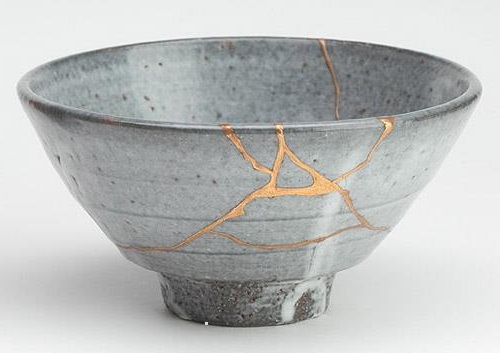
Kintsugi

Do you ever feel like now that you’re in your 30’s you have more wear and tear, maybe a little more scarring, if you will…?

I do. In the physical way, obviously – for instance, I’m starting to see the lines on my forehead, and my pores are larger (which my facialist said was due to gravity pulling the skin downward and thus enlarging the pores, which was somehow terrifying to hear.) But also emotionally. I’ve been let down by friends, been broken hearted, become a touch more jaded, lost some of my idealism, etc.

So when I read about this Japanese practice of Kintsugi, my heart felt happy. According to Wikipedia, Kintsugi is “The Japanese art of fixing broken pottery with lacquer resin dusted or mixed with powdered gold, silver, or platinum a method similar to the maki-e technique. As a philosophy it speaks to breakage and repair becoming part of the history of an object, rather than something to disguise.”

What if we thought of ourselves like this? As if all our so-called ‘failures’ are actually beautiful golden additions to ourselves — armor against negativity, reflectors of light.

Our “brokenness” is something to be celebrated. I know I’m stating the obvious here – but it bears repeating – let’s embrace our history and heartbreaks and remember that they make us who we are.

Sang-Bleu_kintsugi

from sangbleu.com

The Grass is Greener Syndrome

Everything in your life could be better, if only got a new job, moved, owned a dog, ate five servings of vegetables a day, gave up alcohol, ate gluten free, and the list goes on…

Since I graduated college in 2004, I’ve moved to a new apartment every year with the exception of two years. When lease renewal time came around, I always felt I could find a better apartment, a better “fit” for me, or a more fulfilling roommate situation. (In fact, as I’m writing this, I’m thinking about how great a new, bigger apartment would be, despite having just moved three months ago.) Besides all the money I spent on moving costs, there was the psychological toll of moving. Moving can be traumatic and stressful. Every year, I’d lug all my belongings from one Brooklyn neighborhood to another, until I had exhausted all the neighborhoods and at last, borough-hopped to Queens.

Recently, I realized that maybe this was some pattern and indicative of something deeper. And apparently, there’s even a term for this chronic need to find the next best thing. It’s called “the grass is always greener syndrome” or GIGS for short.

This syndrome, “the grass is greener” dilemma,  is not just limited to moving. It can affect all areas of your life. Ever known a chronic job hopper? Or someone who’s always “falling in love” with someone new? I’m not judging this behavior, and in fact, having a desire to improve your life is natural and evolutionarily adaptive. But it gets self-destructive when it infuses everything else in your life with doubt. How can you enjoy a relationship, friendships, a job when you’ve got a nagging feeling that it could be better?

When I moved to LA a year ago, I had all these grand hopes for changing my life. I imagined I’d be more relaxed, eating avocados, walking on the beach, and writing my screenplays all day long…Uh. Yeah, right. As much as I tried to leave my issues in NYC,  I they joined me in California. I still have trouble motivating myself to write for long stretches of time, I still don’t exercise as much as I should, and more often than not, I opt for Trader Joe’s frozen meals over fresh avocados.

But I guess what I am trying to learn and internalize is that there’s great pleasure to be gained in loving a place, a person, a situation for a long period of time. Finding ways to improve upon something and being at peace with “what is.” (This is new-agey Jane coming out now.)

There’s an Eckhart Tolle quote that really speaks to this:

“Whatever the present moment contains, accept it as if you had chosen it.” – Eckhart Tolle


5 Things You Should Leave Behind in your 20’s

Imagine a big suitcase full stuffed to the brim with random clothing, knick-knacks, granola bars, etc. It’s bursting at the seams and the wheels are kinda broke so it makes a scraping sound when you roll it places. All that junk represents the issues of your 20’s.

Now imagine that you’re at the gates of thirty-something-dom. The doors open and the gate-keeper says you must leave this suitcase at the door.

What’s inside the suitcase? Are you okay with letting it go?

Here’s what was in my suitcase and what I recommend you should let go too.

1) Crappy Friends. The kind that aren’t genuinely happy for you when good things happen in your life. The kind that make you feel bad about yourself after hanging out with them. Like George Washington said, “It is better to be alone than in bad company.”

2) Bad boys. The kind that don’t call when they say they will. And when they do, you somehow feel ‘lucky’ they called. The kind that can’t commit after eight months of dating. That kind that make you feel like you’re constantly playing games.

3) Days Lost to Hangovers. It’s not worth it. It’s just not. And okay, can’t say I’ve totally, 100% left these days behind, BUT for the most part, I rarely lose a day to a hangover. Maybe two days a year.

4) Being Tolerated and not Celebrated. I read this quote recently, and it resonated with me. “Go Where You Are Celebrated, Not Where You Are Tolerated.” This includes in workplaces, relationships, friends, extra-curriculars, etc. Find your tribe. They are out there and trust me, they are worth finding.

5) Saying Yes When You Want to Say No. Your time is valuable. Really damn valuable. So ignore the “should’s” (“I should go to that party, but I really want to stay in and read tonight.”) and go with the “want to’s” instead.


Egg Freezing Procedure Covered by Employers Apple and Facebook

You’ve probably heard the news that Facebook and Apple are now offering to pay for an egg freezing procedure for their female employees. Essentially, this policy was put in place to help women free up time to focus on their careers… without the stress of declining fertility and the pressure to have a child stat. You can read more details about their new free egg freezing policies in Bloomberg Business Week’s thorough article: Later, Baby: Will Freezing Your Eggs Free Your Career?

The procedure costs anywhere from $7,000 to $12,000 plus storage fees, which run about $1,000 yearly. The majority of insurers do not cover this procedure.

I’m all for women having flexibility and choice when it comes to deciding when to have children. As someone who’s nearly 33 years old, I know firsthand the stress of wanting to have children but also wanting to get further in my career; It feels like this heavy invisible weight I carry around, knowing I have to make this very important decision soon. For me, egg freezing is not an option, mainly because I don’t have $10,000 to spare. If it were free, I would probably get my eggs frozen. So I’m thrilled that companies like Apple and Facebook are paying for their employees to have extended time to make what is likely the most important decision of their lives.

That said, I’m unsettled thinking that only these elite Silicon Valley companies are offering this ‘perk’- (I have about a .01% hope that bigger, more ‘corporate’ companies will offer this anytime in the next five years). These large companies are the same ones that offer perks like free candy bars with frozen yogurt/ unlimited sweet goodies (Facebook), on-site barber shops (Facebook), Shuttle bus services (Apple), and many more freebies I can only dream of.

The idealist in me wants every woman to have an egg-freezing option, not only women that can afford it, or women that work for one-of-a-kind silicon valley companies who *may* be offering this as a general PR play or HR recruiting tactic.

Doing it for the Beauty

Sometimes a stranger articulates something about yourself better than you ever could.

I work part-time at the college library doing social media. It provides me with much needed extra cash and I happen to love the job. While most of my job involves me sitting in front of my computer brainstorming witty library related things to say or scouring local events to post, occasionally a lost student will wander into the staff area looking for help. I especially love these moments, mainly cause  I like the human interaction and it’s a nice respite from staring at a screen.

The other day, one of those students wandered in. She approached me and immediately it was clear she didn’t speak English well, as I had no idea what she was saying. She looked to be Chinese and about my age, somewhere in her early 30’s. (At UCLA, we have a huge international student population, so it’s very common to have lots of bi-lingual students.) After a few botched attempts of mis-interpreting her, and thinking she was asking for the “coffee” machine, I eventually realized she was talking about the “copier” machine. She was asking me to take her to the area in the library with copiers.

So, as an excuse to stretch my legs and because I realized there was no way she was going to understand my directions, which involve several twists and turns through a very large library, I get up and say, “I’ll take you there.” As we walked together through the library, I engaged her in some small talk. Since she appeared to be around my age, I asked her if she was a graduate student. She nodded and said yes, she was studying mechanical engineering. I told her she picked a good field, and made some quip that she would definitely have jobs waiting for her after school! She seemed to agree with me.

She asked what I studied, and I said I was a graduate student in screenwriting. Writing for the movies. It took her a second to process what I had said, and then she smiled sweetly and said, “Oh, you do it for the beauty.”

And I just felt…well, understood, I guess. The whole summer I was worried about if I would ever sell a script or get a job on a writing staff of a TV show, thinking about MONEY and how I would live, and in one instant, I was reminded, that’s ultimately it’s not about that. I’m here to make something of beauty – something that allows us to connect to each other as human beings. I know, it’s corny, but there’s truth there. My aim was never to make lots of money from something, it was to create something beautiful.

So, thank you stranger in the library.

So you Chose an Artistic Career Path and now You’re in Your 30’s and YOU BE BROKE

Okay, so broke is not the right word. I’m not broke – but I don’t have a sizable savings and buying a nice jacket on a whim at Banana Republic is not an option for me now. But, I am not complaining – because I chose this option. I want to write for TV and Film, and I could be toiling for many more years to get there, ‘there’ being the point where I’m paid for that work. That means though, that I can’t take a job with long hours or a ton of after-work responsibilities because I need time and mental energy to focus on my writing. So I’m stuck in a land of entry to mid level admin type work.

Which isn’t bad – it’s something to be thankful and grateful for – BUT,  as I get older and head into murky early thirties-mid-thirties territory, I worry about the “what ifs,” what if I don’t break through for awhile? What if I’m 45 before I do? All that saved salary I miss will have an impact. How will I afford children, if I choose I have them? Yes, my ‘husband’ can pull more of the weight but what psychological impact will that have on me as a woman? Will I feel it necessary to give up more ‘writing time’ to watch the children because he’s paying more for the household?  And very importantly, what about retirement – how can I keep up with saving enough money to retire one day?

I’m not sure what I’m trying to say with this post, but I do think making this sort of choice highlights something I’ve been thinking about a lot lately. That life is all about paradoxes and compromises. There’s a internal richness that comes with making a decision to follow what some might call a very risky career path, but there’s the flip side of that – which is the very real worry of monetary security.

Screen Shot 2014-10-11 at 8.31.34 AM

A “Thrisis” Is Not A Medical Condition

Ever heard of the word “thrisis”? I hadn’t until the other day, when a wine-fueled googling expedition led me down a rabbit hole of articles about “surviving your thrisis.” It sounded like some strange medical condition, something in between thrush (yikes!) and a thyroid issue. But the word “thrisis” actually refers to the mental and psychological “crisis” that one experiences during their thirties, not unlike a mid-life crisis.

I’m not sure where the term began or who exactly coined it, but it’s been popping up in articles and blogs. While everyone seems to have some different version of it, the common themes and complaints of a “thrisis” seem to be:

  • “Now that I’m 34, my life doesn’t match up with how I thought it would be.”
  • “I’m a corporate professional and I’ve reached a high-level in my company and have a corresponding salary, but how come I don’t feel fulfilled?”
  • Basic feeling of being underwhelmed with your life
  • Feeling less “black and white” about life and choices, and more “grey”

There’s even a book about having a “thrisis” – it’s called “30-Something and Over It” by Kasey Edwards.

In her book, Edwards talks about how the experience of having a “thrisis” can help you “take stock” of your life so you can avoid having regrets down the road. She writes, “It’s about looking ahead, thinking, I don’t want the next 30 years to be like this.”

I’ve definitely thought about this in terms of my own life, and yes, I do have occasional freak outs about feeling “behind” as a thirty-something. I don’t have a solid set of career accomplishments, I’m not married, and I don’t have children. But since I’m still climbing the ladder towards my career as a screenwriter and TV writer, the common ‘thrisis’ feeling of reaching a high level and not finding fulfillment isn’t resonant for me.

How about you? Have you had a “thrisis”?

How many of your friends know your salary?

What do you think about sharing salary details with your friends?

In my twenties, I knew what most of my friends were making. That was because we were all in the same boat – or rather the same entry-level dingy. We were all making anywhere from 22k to 45k in our starter jobs, with some outliers of course. But because we were in a similar salary range, it was easy subject to talk about in our twenties. In fact, it brought us closer – we commiserated by finding the best happy hours in the city and living in shitty apartments with roommates we found on craigslist.

Now that I’m in my early 30’s, I don’t know a single friend’s salary except Laura’s, but even that’s a rough estimate because it changes every year because of the nature of her job. I know Laura’s salary because we enjoy talking about money and saving together. We even have an informal “money club,” where we talk savings ideas and salaries. Maybe it works because we made about the same amount (before I left for graduate school; now I’m just diving into savings constantly). But aside from Laura, I don’t know the salaries of my closest friends.

From around 27 and up, salaries of your peers diverge greatly. Some people choose to go the way of the artist and take day jobs while they spend nights and weekends working on their side projects.  Others choose the more corporate path and get their MBAs or law degrees, likely making six figures and up. So it becomes awkward when the disparity is so large.

What would happen if we did share our salaries? Are we afraid of the jealousies that would creep up? Or the divides that would suddenly appear? Is salary information simply just not that important anymore? Or are we too polite?

For those curious, here is some interesting salary information:


Friendship Changes in Your Thirties

Five years ago, I was 27. When I think back to that time, I realize that I still have the same group of close friends now. We may not see each other that often because of living across the country from each other, or having children or marriages that demand time and responsibility, or a host of other reasons. But when we reconnect, the closeness always feels there, though the frequency of our communication  has shifted over the years, ebbing and flowing.

But, when I think back to when I was 23 and to who my friends were then, I realize the circle was quite different and I’ve lost about three very close friends. One was about a specific incident, one happened because we simply changed and faded away from each other, and the other one was somewhat inexplicable. It lowered my self esteem for years; I wondered what was wrong with me – had I changed in some profound way that made me unlikeable? Was something fundamentally wrong with me because I couldn’t keep lifelong friendships?

I’ve found none of the above to be true. Actually, what I’ve found seems to happen in your early-mid twenties is a kind of subconscious friendship purge. As you go through your twenties, you change rapidly and your friends starting to reflect the changes in your life. You’ve brought a lot of baggage from your “college self” and your “adolescent self” into your twenties and you’re shedding it as you move through that decade of your life- and your friendships are bound to reflect that shedding process.

Now that I’m 32, I feel like the close friends I have now will remain close in the future. Once you get to your early 30’s, you’ve weeded out most of the people that just aren’t working for you.

In your thirties, you start to realize you really need to be uplifted from your friends. Toxicity just won’t do. Life is too short for people who don’t celebrate you. I love this quote from Mother Teresa- and it’s applicable to friendships:

 “Let no one ever come to you without leaving you better and happier.” – Mother Teresa