OMG I'm Thirty

Everything You Should Know About Your Thirties

Skip to content
  • Home
  • About Us
  • Career
  • Friendships
  • Health and Wellness
  • Money
  • Relationships
  • Grab Bag
  • Spirituality
  • Travel
  • 30 Quotes About the Thirties Book!

Tag Archives: Savings Account

What Is an HSA and Should I get one?

September 24, 2017 By laurasomewherelse in Money Tags: 401(k), ACA, health insurance, Health Savings Account, HSA, Insurance, IRA, Retirement, Retirement Account, Savings Account, thirties, Thirty, what's an HSA? Leave a comment

With Health Insurance possibly overhauling entirely in America in the coming years, and with the rocky fate of the ACA always up in the air, health insurance has been on my mind lately.

As a completely self-employed individual, I have a health care plan from the ACA marketplace. Before this, I had no health insurance at all since getting off of my parents’ plan in my twenties. Nowadays, because I try to be as financially responsible as I can, I really don’t like the idea of not having health insurance. Besides the tax consequences where you must pay a fine if you don’t have health insurance come tax time, I don’t like to take gambles with large amounts of money. So I don’t like the idea of suddenly being hit with huge medical bills that could’ve largely been covered by insurance, if I had it.

Even though I’ve had people tell me things such as I don’t need health insurance because I’m a healthy vegan, because I’m paleo, because I do crossfit, because I’m a marathon runner, because I have a connection with the universe, etc, none of those things will help you if you god forbid get hit by a car (okay, maybe your connection with the universe will… that’s hard to beat). But mainly, if something happens to you that can’t be completely controlled by nutrition or exercise, you want health insurance as a just-in-case.

On a couple of finance podcasts, including Paula Pant’s Afford Anything, the HSA (Health Saving’s Account) has come up a few times and has peaked my interest. Basically, an HSA is a savings account where you can contribute up to a tax deductible $3,400 ($6,750 for families) that can be used for medical expenses. Because the money you contribute to an HSA is tax deductible, whatever you contribute to it is a tax write-off, which is a nice benefit to this type of account.

So basically, if you have an HSA, the money accumulating inside of it is supposed to be used for health-related expenses (except for health insurance payments- it primarily cannot be used for that, which is disappointing). There’s good news and bad news here. If you use the money for healthcare related expenses, it will never be taxed, so that’s great! If you use the money for anything other than health related expenses before the age of 65, you’ll owe a 20 percent penalty. Womp womp. So anything you place inside your HSA should be money that you won’t need to to spend unless you’re in a healthcare emergency- which only makes it a good retirement vehicle if you know you won’t touch it for anything besides healthcare and retirement.

Even with these drawbacks, the HSA is an interesting and possibly very helpful supplemental savings vehicle for retirement. I use the word supplemental because you can only stash $3400 in it a year, so it would go along well with your normal 401K (where you can stash a max of $18,000 a year) and/or IRA/Roth IRA (where you can stash a max of $5500 a year). Since the money can only be used for healthcare BEFORE AGE 65, that leaves the money up for grabs AFTER 65. Here’s how a lot of people who can afford it are  using the HSA as a backdoor way to have extra money for retirement:

  1. When you have an HSA, you must get a healthcare plan that goes with it. These are specific, high deductible plans, where the deductible (what you’d pay out of pocket) is at least $1,300 with a max of $6,550 (after which you’d be covered). This means that if you’re considering an HSA, you may have to change health insurance plans, because only certain plans are compatible.
  2. Once you have an HSA and compatible insurance plan, you can use the HSA as a supplemental retirement strategy by paying your healthcare costs out of pocket, and saving the receipts. To use this money for retirement, you don’t want to have to actually take the money out of your HSA until you’re 65 (or even later), so you can let it all grow tax-deferred without diminishing it.
  3. After you’re 65, you can take the money out with no penalty, but you don’t HAVE to start taking money out at a certain age (the way you have to with many traditional retirement accounts). You can take the money out whenever you want, as it continues to grow interest, which is a nice benefit.
  4. The money in your HSA isn’t just sitting around, the way it would be in a traditional savings account (giving you 0.025% to 1.20% interest). The money is actually invested in a possible variety of mutual funds and investments (exactly which investments these are depends on your HSA and what’s available to you). Therefore, as a retirement savings supplement, your HSA is a nice investment vehicle.
  5. The reason you might hear HSAs referred to as having triple tax benefits is because 1. All contributions to HSAs are pre-tax (as I talked about above, anything you contribute, you can write off on your tax bill), 2. The HSA account value grows tax-deferred (you don’t pay taxes on the interest you’ve made until you withdraw the money and you never pay taxes on any of it if you withdraw the money for medical care), and 3.“Qualified” distributions from your HSA—those used for medical expenses—can be withdrawn free of income taxes. So that’s three tax benefits right there.

The HSA is a fairly new type of healthcare plan to have, so we’ll see how it grows and changes. As of now, the drawbacks are:

  1. You don’t necessarily get the same types of investment options as you get in a typical 401K or IRA. There may be more fees associated with these investments- which can cut into the tax benefits you’re gaining.
  2. You must have high-deductible insurance. This means that in order to use the HSA as an effective retirement vehicle, you have to pay most of your medical bills out of pocket (not using the HSA money, because then you wouldn’t have it for retirement) until you reach the deductible limits.
  3. If you don’t have extra money to sock away for retirement, and/or you’re not great with saving money that can be used for health care costs, an HSA probably isn’t for you.

The HSA is an interesting possibility for extra retirement money, and a lot of financial advisors are excited about it. As of now, I don’t have one because I’m still filling up my Roth IRA, but it’s on my mind as a possibility for the future.

If you want to read more about pros and cons of HSAs, here are some articles I found helpful:

From Nerdwallet (always a great source): What is an HSA?

From The Balance (these guys LOVE the HSA): Why You Might Want to Fund an HSA Over an IRA

From Forbes (triple tax benefit explanation): Why every 50 year old should be maximizing an HSA

From Marketwatch (health dose of cynicism balanced with benefits): HSA Accounts- The Good News and Bad News

Hope this is helpful! As always, let me know if you have any questions or comments in the comment section below.


Share this:

  • Click to email a link to a friend (Opens in new window) Email
  • Click to share on Facebook (Opens in new window) Facebook
  • Click to share on X (Opens in new window) X
  • Click to share on Pinterest (Opens in new window) Pinterest
  • Click to share on LinkedIn (Opens in new window) LinkedIn
  • Click to print (Opens in new window) Print
Like Loading...

If I Have Extra Money, Should I Invest It?

August 22, 2017 By laurasomewherelse in Money Tags: 401(k), Emergency Account, emergency fund, Index Funds, investing, Retirement Account, Roth IRA, Savings Account, stock market, thirties, thirtieth birthday 2 Comments

I recently wrote an article about the best savings accounts and received quite a few comments about investing the money in “safe, high-rated” stocks instead of a 1-1.5% interest savings account.

I would love to do this – invest in stocks and get a possible 7-10% return on my money instead of the paltry under-2% return that savings accounts provide, except for one main problem:

I don’t have enough in my emergency fund yet.

What is an emergency fund? It’s a cushion of money that isn’t invested in anything which provides a cushion in case of a money emergency. This money must be immediately accessible. The money can’t suddenly drop to near zero because of a market freefall- it needs to be reliably there for you.

How much money should be in this emergency fund?

Most experts recommend emergency funds hold between 6-8 months of income. This means that if you make $3000 a month, an emergency fund should have $18,000- $24,000.

Why do I need so much money in my emergency fund?

What if, god forbid, you lost your job tomorrow or got hit by a car and were stuck with insane medical bills and possible disability that prevented you from working? It might take awhile to get back on track again. If you lost your income for a few months, you need to be able to cover major expenses for a that time with a cushion of money. Otherwise you might go into extreme debt. And if you go into debt, you will get hit with insane interest on any kind of loans you might have to take out. An emergency fund is like a loan to yourself…with no interest. 

Why can’t I invest this emergency fund?

Because even with the “safest, top rate stocks,” the market isn’t safe…you can’t time the market. Your cushion of invested emergency money could drop down to next to nothing at any point. And if your emergency fund is invested and you have an emergency, you’ll need to pull the money from the market. And if the market is at a ‘bad’ time, you won’t be able to wait until it recovers, so you’ll be at a major disadvantage and could end up pulling your money at the worst possible time and losing a ton of $$$.

If my emergency fund is already at 6-8 months, can I invest additional money? 

Sure. I would recommend investing in a retirement account first, such as a Roth IRA, or your work 401k, and contributing the max, or at least 15% of your monthly income. I recommend starting with retirement investing because retirement funds are tax protected, meaning you won’t get taxed on your earnings right now (you’ll NEVER get taxed on them with Roth IRAs). THEN if you still have additional income, go ahead and invest intelligently…maybe in some index funds. Or, if you have what some of my favorite financial advisors call a “burning garbage pile” fund, invest some money in individual stocks…but only invest money you’re cool with possibly losing. Hence the ‘burning garbage pile.”

I know it’s hard to save for emergencies- I’m not fully funded myself…but I’m working on it. Do what you can. Be safe and be prepared!

And of course, let me know in the comments if you have any questions.

15ff842b044a8c7368a800e8d229d956--money-affirmations-cash-money


Share this:

  • Click to email a link to a friend (Opens in new window) Email
  • Click to share on Facebook (Opens in new window) Facebook
  • Click to share on X (Opens in new window) X
  • Click to share on Pinterest (Opens in new window) Pinterest
  • Click to share on LinkedIn (Opens in new window) LinkedIn
  • Click to print (Opens in new window) Print
Like Loading...

Are You Saving Enough In Your Thirties?

July 14, 2017 By laurasomewherelse in Grab Bag, Money Tags: ally bank, barclays savings account, emergency fund, emergency savings, goldman sachs savings account, gs bank, saving in your thirties, Savings Account, Suze Orman, synchrony savings account, thirties, Thirty 4 Comments

Multiple friends recently asked me about savings accounts- the best places to have them as well how much to save. A few optimistic questioners asked if there were places where 5% or 10% in interest exists- or even more.

I’m sorry to let anyone down, but as of this moment, there are no magical savings accounts that will give you 5%+….or even 2%+. Not for regular savings accounts anyway. I wish there were.

If you want to withdraw your money anytime anytime in the near future, which is what emergency savings accounts are for, you need to have an account where your money is easily withdrawn. Other types of savings vehicles, such as CDs, (which are savings vehicles that let you leave your money in for a long time (not for emergencies)), used to promise at least a decent interest rate in exchange for locking up your money for years, are now offering paltry returns way below 2% (not worth it).

However, even though savings accounts today aren’t what they used to be, you should still have one. Here’s why. What if you have a medical emergency, or a major repair in your household? Or what if you suddenly lose your job or, god forbid, get hit by a car and become disabled? There are all kinds of money emergencies that come up out of nowhere. You need to be able to have some money to draw upon so you don’t become debt-ridden or bankrupted by a surprise expense. That’s where the emergency savings account comes in.

Financial experts disagree on exactly how many months of income you should aim to put away, but the responses average around 6 months, with more conservative experts, such as Suze Orman, advising 8 months of income in an emergency fund. So whatever you make a month, post-taxes, multiply by anywhere from 6 to 8, depending on how safe you’d like to be. That’s the goal for your emergency fund.

So if I make 3,000 a month after taxes, and I want a 6 month emergency fund, I should have $18,000 (3 x 6 =18) saved that I’m not touching to go get my nails done or go see Hamilton in the center orchestra. That money is for emergencies.

Now, your emergency fund should not be invested in the market or in real estate or in anything- it should be ready to grab at a moment’s notice. So where SHOULD you keep your emergency fund?

The people who asked me about savings accounts were currently keeping extra money in their banks, where it was making something like .003% interest. Now that’s REALLYYYYY low, even in the land of savings accounts. So below are places where you can currently get 1%- 1.20% interest on your savings, as of July 14, 2017. Here are the top ones from my research:

  • GS Bank (Goldman Sachs), which is at 1.20% right now. They’re online only, which is fine with me, and they’re what I use. You can start an account with as little as $1. Here’s the link to GS.
  • Syncrony is at 1.15% right now. They’re also online only.  You can start an account with as little as $1. Here’s the link to Synchrony.
  • Ally is at 1.15% right now. Online only, and very popular.You can start an account with as little as $1. Here’s the link to Ally.
  • Barclays is at 1.15% right now. They have some branches if you link brick and mortar as well as online. You can start an account with as little as $1. Here’s the link to Barclays. 
I get no commission from these links (I wish)- they’re just the best places to save based on the research I’ve done.
So, if you have absolutely nothing squared away for savings, never fear- just start right now. Whenever you get a paycheck, take 5% (or even 10% if you’re feeling ambitious) and put it into a savings account. Automate this if you can- I swear you won’t miss it!
Aim low at first. Try to get to $1000 to start for emergencies- that’s wayyyy better than nothing. Then build up. I haven’t personally hit my 6 months emergency savings account either, but I’ve begun.
I swear, with savings accounts, starting is usually the hardest part. But then you’ll be SO happy you have a buffer.
piggybankmoneysavingsmi600-resize-600x338


Share this:

  • Click to email a link to a friend (Opens in new window) Email
  • Click to share on Facebook (Opens in new window) Facebook
  • Click to share on X (Opens in new window) X
  • Click to share on Pinterest (Opens in new window) Pinterest
  • Click to share on LinkedIn (Opens in new window) LinkedIn
  • Click to print (Opens in new window) Print
Like Loading...

What Are My Retirement Account Options If I’m Self-Employed in My Thirties

December 3, 2015 By laurasomewherelse in Money Tags: 401(k), contribution, Debt, individual 401k, Interest, IRA, Job, Money, Retirement, Roth IRA, roth solo 401k, Savings, Savings Account, self-employed, sep ira, simple ira, solo 401k, Student loan, thirties, Thirty 2 Comments

So hopefully by now you’ve opened up your Roth Ira or Traditional IRA. Even if you’re not self-employed and have a 401k plan at work, it’s still a great idea to open up a Roth, and it’s never too late. Here’s how to open a Roth IRA right now. 

If you already have a Roth IRA and/or a traditional IRA, you probably know that the maximum contribution you can make to both (total) per year, as of 2015, is $5,500. Then you have to wait till next year to contribute another $5,500. If you’re 50 or older (and if you are, you’re awesome and I appreciate that you’re still reading our blog about the 30s), you can contribute an additional $1000, totaling up to $6,500.

Because I’m still paying off my ridiculous NYU student loan, $5,500 a year is about the most I can contribute to my Roth IRA anyway right now. But that won’t be always be the case. So what happens when I want to contribute more than the $5,500 a year Roth IRA cap, but I’m self employed so I can’t open up a 401k at my workplace?

There’s a solution. There are actually multiple solutions.

A self-employed writer friend of mine recently told me that she’d hit the limit for the year on her Roth IRA and was currently holding on to extra money in her bank account while making less than 1% interest (most bank accounts and savings accounts are 1% interest or less). “Roth IRA’s have such a low cap,” she said to me, “$5,500 compared to $18,000 in a workplace 401K. Are we completely at a disadvantage since we’re self-employed? What should I do?”

Holding onto your extra retirement money in your savings account is not a good solution, because your money won’t earn enough interest for retirement. You should, of course, have an emergency savings account, but that account is different from your retirement fund. So without further ado, here are some great choices for retirement accounts if you’re self employed. And these are IN ADDITION to your Roth IRA (which I hope you’ve opened!)

My favorite option: The Roth Solo 401K (also called the Roth Individual 401k)

Why it’s great: You can contribute up to $18,000 in 2015! That’s fantastic, and is the same contribution limit as the one on a 401k you’d get working at a “real job”.. (most day jobs). Also, there are Solo 401Ks and Roth Solo 401ks, but I love the Roth, because all the money compounds and gathers interest in your account for years and years, and when you receive it after retirement, EVERY PENNY will be tax free. AMAZING!

Drawbacks: If you have employees, you can’t open one of these. Only you and your spouse can participate. Also, if you’re self-employed AND working a day job, you’ll be able to contribute only $18,000 to your workplace 401k and your Solo 401k TOTAL (so probably not the best option for day-jobbers with workplace 401ks).

How to open a SOLO 401k: You have until December 31st. Try opening one at Vanguard, which is my favorite place to open Roth IRAs because of the low to no fees involved.

Another Good Self-Employed Reirement Fund Option: The SEP IRA (Simplified Employee Pension Individual Retirement Account)

Why it’s good: You can contribute as much as 25 percent of your earnings to this IRA, up to $53,000 for 2015. That’s a lot of money! Also, this IRA is very simple to set up. You can probably set one up online in 15 minutes or so.

Drawbacks: You’re not able to make the SEP IRA into a Roth SEP IRA. This is a major drawback, as you’re able to take tax deductions now (every dollar you contribute to your SEP IRA you can write off your taxes now, which is nice), but when you withdraw money in retirement, every penny will be taxed, including all your investment earnings. This is helpful right now for a tax write-off, but not good in your retirement years. Also, this plan may be costly if you have employees, as you’ll have to contribute for them as well. 

How to open a SEP IRA: Again, I usually recommend Vanguard, but do your research. T Rowe Price and Fidelity also looked like good options.

Great Option if you have employees: SIMPLE IRA (Savings Incentive Match Plan For Employees)

Why it’s great if you have employees: The SIMPLE IRA was basically designed for self employed business owners with employees. If you have a few employees, maybe 3-10, and they make more than $5000 a year, but way less than 100K, this is a good one for you. It’s also easy to set up and should take you 15 or so minutes online.

Drawbacks: If you have more than 100 employees, the SIMPLE IRA might not be the right plan for you- this was designed for smaller businesses. Also, if you have a day job with a 401k, you’ll be able to contribute only $18,000 to your workplace 401k and your SIMPLE IRA TOTAL (so probably not the best option for day-jobbers with workplace 401ks). The deadline was October 1 to open one for 2015, but you can still open one for 2016.

How to open a SIMPLE IRA: Here’s Vanguard again, and you can also try Scottrade, Fidelity, and T Rowe Price.

Hope this was helpful! Enjoy your awesome self-employed life while you build just as big a nest egg as your friends with day jobs!

IMG_8061 (1)

The glamorous world of working from home a lot when you’re self-employed (hint: not so glamorous).


Share this:

  • Click to email a link to a friend (Opens in new window) Email
  • Click to share on Facebook (Opens in new window) Facebook
  • Click to share on X (Opens in new window) X
  • Click to share on Pinterest (Opens in new window) Pinterest
  • Click to share on LinkedIn (Opens in new window) LinkedIn
  • Click to print (Opens in new window) Print
Like Loading...

Help! I Need Money! Can I Borrow Money From My 401K or IRA Retirement Account?

July 14, 2015 By laurasomewherelse in Money Tags: 401(k), borrow, Debt, financial advisor, IRA, Money, Retirement, Retirement Account, Roth IRA, Savings Account, Suze Orman, thirties, Thirty 4 Comments

Congratulations on having a retirement account! If you have a retirement account with at least some money in it in your thirties, you’re way ahead of most of the American population. If you don’t yet have a retirement account click here for info on how to set one up.

Since financial education isn’t really taught in American schools (though it should be!), it took me until age 28 to realize I should open a retirement account- and I only figured it out because I started listening to tons of finance podcasts. A lot of people I know are the same way- opening retirement accounts late in life or wondering in their thirties whether to open them at all yet. Some people are lucky and have money automatically placed into a 401K through their job. However, if your job offers you a 401K, make sure you’re actually enrolled in the program. More than one close friend of mine realized that they weren’t automatically opted in to their workplace 401K, and had ended up missing out on years of compounding interest in their retirement accounts…because they weren’t saving anything!

So..back to the title of the post. Let’s say you suddenly need money and for whatever reason, you haven’t saved anything in a savings account. What should you do?

Well, if you’re considering taking money from your retirement account, think twice. This is usually a very bad idea, and should not taken lightly.

Here’s some advice for what to consider before you pull money from your future (also known as your retirement account):

  • Do you really NEED to buy this? The financial advisor Suze Orman always distinguishes between needs and wants. If you’re trying to buy a car because you have no car and absolutely can’t get to work without one, that’s a need. If you’re trying to buy medication for your diabetes, that’s a need. If you’re buying a new coach bag, that’s a want. If you’re buying a vacation, that’s a want. If what you’re buying is a NEED, then continue reading. If what you’re buying is a WANT, don’t even THINK of pulling money from your retirement account!! Stop right now! Wait until you’ve saved money in a savings account!
  • What type of retirement account do have? Choose below:
    a. A 401k
    If you have a 401K, it’s a really bad idea to take money from it before retirement unless you’re absolutely, totally desperate and what you’re buying is a NEED (and taking money is still a bad idea even then.) You’re going to be hit with a 10 percent penalty fee right off the bat, plus you’ll have to pay taxes on the money taken.

B) An IRA (Individual Retirement Account)
If you have an IRA, it’s also a really bad idea to take money from it before retirement unless you’re absolutely, totally desperate and what you’re buying is a NEED (and once again. it’s still a bad idea.) Same penalty fee and income taxes owed on the amount taken as the 401K. You’re going to lose so much money in the process of doing this! There are a few exceptions to having to pay the fee though – read about them here.

C. A Roth IRA

This is still a bad idea unless you’re absolutely, totally desperate and what you’re buying is a NEED, but it’s your best retirement account option. The wonderful thing about Roth IRAs is that they are kind of like savings accounts in that you can borrow from them at any time without fees or taxes owed. However, you can only borrow from the money you’ve contributed and not the interest earned. But if you take money out (which I don’t advise because you’re hurting your retirement account and it’s ability to compound and generously earn you more money), at least you aren’t getting charged a fee and taxes on money you’ve borrowed from yourself!

This is yet another reason to open a Roth IRA if you don’t have one yet!

Hopefully you’ll never get to the point where you absolutely need to borrow money from your retirement account. But if you do, I understand, and I get that you’re in a very hard situation.

Hopefully this has been helpful, and you now know that borrowing from your retirement accounts should be your absolute last option!

download (7)

Share this:

  • Click to email a link to a friend (Opens in new window) Email
  • Click to share on Facebook (Opens in new window) Facebook
  • Click to share on X (Opens in new window) X
  • Click to share on Pinterest (Opens in new window) Pinterest
  • Click to share on LinkedIn (Opens in new window) LinkedIn
  • Click to print (Opens in new window) Print
Like Loading...

How to Pay Attention to Your Dollars in Your 30s

December 8, 2014 By janersays in Money Tags: Aging, budget, Debt, dollars, lessons, Money, Savings Account, spending, thirties, Thirty 1 Comment

Since I’m in my final year of graduate school, I try not to think too much about saving money, only because I have no money coming in. Okay, that’s somewhat of a lie – I do have a part-time job at the library where I write and post social media content. But all of that small amount of money goes straight to everyday expenses and rent. I also occasionally find coins on the street. Does that count?

Even though I don’t have real money coming in, I do get excited about the prospect of being able to budget and save money in a real way once I graduate. So today, when I was avoiding working on my final projects and was instead taking a stroll in the wonderful land of the internets, I found this article: “7 Financial Decisions Made In Your 30s That May Haunt You in Your 50s.” There’s nothing like fear to make me click.

The article has a lot of good tips and ideas for saving money and it’s definitely worth a read.

This tip was my favorite:

Pay Attention to your Dollars 

The author writes:

“If I could take back what I spent in the past twenty years on coffee, clothes I bought on sale but rarely wore and my “guilty pleasure” books, I’d be a wealthy woman.” – Nancy Anderson

It’s so simple, right? But so hard to internalize and practice regularly. What are your indulgences? Mine are definitely drinks – from $4 lattes to $1.89 diet cokes to $7 glasses of cabernet. It’s hard to just start cutting these seemingly small indulgences out of your life. As silly as it may sound, these treats bring me great happiness in my day.

Now, the question is: How to pay attention to the dollars? (For some people budgets work. I’m not a budgeter, but like I said, that’s mainly because I have no money coming in.)

For me, two things have helped. 1) Keeping a journal of what I spend. I go through phases of this. Certain days I am religious about it, and then I drop off for a bit. But basically, the gist of it is that I write down EVERYTHING I spend that day, including the $1.50 for the bus. It helps to get a basic idea of what you’re spending everyday.

2) I set a daily limit. My daily limit is somewhat high, but you’d be surprised how quickly it goes. I try and spend about $30 a day. Now, this may SEEM like a lot, but really try and do it, and you’d be surprised how hard it is. Many days earlier in the week, I only spend $10-12 on food, drinks, etc. But when it comes to Thursday-Sunday, it gets harder. There are social functions – dinners, drinks, movies. A meal out, with a drink and tip, will generally cost $25-27 (at the types of places I go to.) So this means that I have to spend $3 the rest of the day, or eat into the other days. Which is generally what happens. For instance, I spend just $10 one day, and then one weekend day, I spend $50 when I end up going to see a play or movie and pick up a bottle of wine for a party.

What works for you? How do you pay attention to the dollars?

Share this:

  • Click to email a link to a friend (Opens in new window) Email
  • Click to share on Facebook (Opens in new window) Facebook
  • Click to share on X (Opens in new window) X
  • Click to share on Pinterest (Opens in new window) Pinterest
  • Click to share on LinkedIn (Opens in new window) LinkedIn
  • Click to print (Opens in new window) Print
Like Loading...

401K, Roth IRA, Retirement Accounts, Oh My! Should I Save in My Thirties?

November 10, 2014 By laurasomewherelse in Money Tags: 401(k), Dave Ramsey, Debt, Money, Retirement Account, Roth IRA, Savings Account, Student loan, Suz, Suze Orman 18 Comments
401K, Roth IRA, Retirement Accounts, Oh My! Should I Save in My Thirties?

Oh retirement accounts! What a sexy subject to talk about!

Woohoo, 401Ks- so hot! Steamy, racy Roth IRAs! Let’s put away a bunch of our hard-earned money in an account we don’t touch for 30 years! Don’t take that fancy Miami Beach vacation or buy those sizzling Leboutin shoes- fund your old age instead! Forget traveling the world now- save your money for when you’re 70!

No wonder no one wants to talk about putting away money for retirement. It’s depressing. And mysterious. Retirement accounts are neither straightforward nor seductive and they weren’t taught in school. So what should we do? Should we quit on them? Take a vacation instead? Carpe diem?

Fund vacation vs fund Retirement...hmm..can I just close my eyes and pretend I didn't hear the question?

Can I just close my eyes and pretend I didn’t know about retirement accounts?

The answers are out there, you just have to dig a little. If I hadn’t started listening to podcasts a bit over a year ago, I probably never would have started a retirement account. Retirement funds just didn’t seem important or pressing. After all, I’m self-employed, so I can’t have a 401K anyway..right? And I’m young, so I have plenty of time…?

The podcasts of Suze Orman and Dave Ramsey set me straight and changed my attitude fast. Now, I’m no expert, but if there’s one thing I’ve learned from Suze and Dave (and multiple other financial experts) it’s that retirement accounts are really frigging crazy important…way more so than I ever knew. You don’t want to get to retirement age and have nothing to live on! That wouldn’t be good. And social security isn’t enough, nor is it reliable.

So it’s very important to start funding your retirement account. Here are two important and easy first steps:

1. If you’re earning money, start or continue funding your retirement account now. The thirties are definitely NOT too early a time. Some people started in their twenties or earlier, and they are way ahead. Any little bit helps…do what you can afford.

2. Don’t get overwhelmed. If you make very little money, it’s okay to start small. Jane is currently a screenwriting grad student, and is busy studying her craft. She was worried about not being able to put much into a retirement account while she’s still a student. But it’s okay! If you’re currently a student (and making very little to no money), relax! Graduate first and find a job before worrying about your retirement account. You get a free pass for awhile when you’re in school…it’s not worth stressing about. Just start contributing once you can afford it.

As I said before, I’m not an expert, but since starting to understand retirement accounts, I’ve done dozens of hours of research on the topic…choosing the best place to open a retirement account, understanding my options, thinking about tax benefits, and much more. It can get dizzying, but is actually much simpler than it seems once you get the hang of it.

There’s a lot to talk about regarding retirement accounts and I’ll only scratch the surface now (spoiler- there will be more info next week).

So first off, some questions for you to consider:

1. If you’re employed, do you already have a retirement plan through your job?
a) If yes, do you know how much you’re contributing? Do you know what investments are in your plan? Does your employer match your contributions?
b) If no, why not? Does your employer not offer a plan? Are you funding an individual retirement account (IRA) instead?
c) If you’re unsure, find out!
2. Are you self-employed?
a) If yes, have you started a retirement plan for yourself?
3. Are you currently a student or unemployed?
a) If yes, are you stressing about retirement accounts? (Hint: don’t. I already explained why above.)

These questions will start you on the path to understanding your retirement account options. There are many options, but below are detailed descriptions of the most common retirement accounts:

1. 401K

  • A 401K is a standard retirement plan offered by many employers.
  • If you are currently employed (but not self-employed), see if your employer offers a 401K. Most do, but you won’t usually be automatically enrolled! So ask!
  • Many employers will contribute some sort of match when you put money into your 401K. If they do, always contribute at least up to the match! You’re getting free money!!
  • As of 2014, you can contribute up to $17,500 to your 401k. To hit the max, you would contribute $1,458 per month or $729 per paycheck if you are paid twice per month.
  • The money you contribute to your 401k is tax-deductible. You don’t pay taxes on it now. You will have to pay normal taxes on it when you take it out during retirement.
  • If you withdraw money from your 401k before age 59.5, you will have to pay a 10% penalty, plus pay taxes on the money withdrawn!

2. Regular IRA (Individual Retirement Account)

  • An IRA is an account you open up on your own, not through your employer. As of 2014, you can contribute up to $5,500 annually.
  • You do NOT have to be self-employed to open an IRA.
  • You can have a 401k at work and ALSO open an IRA. You will still be able to contribute the maximum to both. But if you have to choose (i.e., you don’t have tons of money to spare…I can relate), I recommend (Suze Orman always recommends this) you contribute to your 401k up to your employer match, and then put any additional money into an IRA (or even better, a ROTH IRA, explained below).
  • The money you contribute to your regular IRA is tax-deductible. You don’t pay taxes on it now. You will have to pay normal taxes on it and any money it earns when you take it out during retirement.
  • If you withdraw money from your regular IRA before age 59.5, you will have to pay a 10% penalty, plus pay normal taxes on any money withdrawn!

3. ROTH IRA

  • Just like a regular IRA, a Roth IRA is an account you open up on your own, not through your employer. As of 2014, you can contribute $5,500 annually, BUT—
  • If you have a regular IRA already, you can’t contribute $5,500 a year annually to BOTH- it’s $5,500 TOTAL. So you have to choose..or have a little money in both.
  • You can have a 401k at work and ALSO open a ROTH IRA. Same deal as above…you will still be able to contribute the maximum to both, but make sure you take the employer match on the 401k first before putting additional money in the ROTH IRA.
  • The money you contribute to your regular IRA is NOT tax deductible. You pay taxes on it now like any other money. However, YOU WONT HAVE TO PAY TAXES ON IT OR ANY MONEY YOU’VE EARNED FROM IT WHEN YOU WITHDRAW DURING RETIREMENT. This is very important, because and it’s what makes the Roth IRA so neat.
  • If you withdraw money from your ROTH IRA anytime, it’s ok! As long as you withdraw money you’ve deposited and not money earned, you’ll have NO penalty or taxes! So Roth IRAs are kinda magical, cause they double as a savings account.

That was a lot of info. I’m going to stop here before this gets way too long and overwhelming. Please ask any questions you might have, and I’ll continue next week! I’d love to hear from you, and your comments help me know what to talk about in other retirement account articles.

Was this helpful? Did you already know all this? Please let me know either way. Thanks for reading! 🙂

Share this:

  • Click to email a link to a friend (Opens in new window) Email
  • Click to share on Facebook (Opens in new window) Facebook
  • Click to share on X (Opens in new window) X
  • Click to share on Pinterest (Opens in new window) Pinterest
  • Click to share on LinkedIn (Opens in new window) LinkedIn
  • Click to print (Opens in new window) Print
Like Loading...

Paying Off a Home Mortgage by Thirty

November 3, 2014 By laurasomewherelse in Money Tags: Apartment, friendship, Job, Money, Mortgage, NYC, Savings Account 1 Comment

A few weeks ago, a 30 year old friend of mine asked me about my new apartment. I had moved in August, leaving one Queens neighborhood for another.

While asking about my roommates, room size, and building amenities, my friend also inquired about price.

I trepidatiously told her how much I pay in rent. I love my new apartment, but had to pay slightly more in rent than I used to pay, so was a little hesitant. Even though I still have a pretty good deal for NYC prices, my friend is from the midwest, and people from anywhere other than NYC and San Francisco usually go pale at the prices you can pay to rent even a room in the city.

After I told her, I inquired about her living situation and how much she paid in rent…or paid toward her mortgage. That’s when she leaned in and quietly told me that she’d actually already paid off her over $250,000 mortgage for her quite large condo. She told me in a humble way, but I still gasped. She works in the exact same industry as I do, and is also self-employed. She’s been doing what I do now for only a bit longer than me, but she still managed to pay off an entire home for herself.

I wasn’t even jealous- I was just amazed. I was amazed at what people can do with money when they put their minds to it. I was actually proud of her- it’s rare to hear something like that. I was humbled that she even told me about it.

Granted, living in New York City is expensive, and buying a condo I’d want to stay in would possibly cost me at least half a million. AT LEAST. (And I’m guessing…I haven’t even investigated prices). And granted, I’ve been paying off my exorbitant student loan for what seems like forever, so my money’s been going there, but still. She made me want to be even better with my money. It’s not all about how much money you make- it’s about what you do with it.

There are people all around me doing what I thought was unlikely or even impossible with money. They may be doing it quietly and staying under the radar- not bragging, just doing. It’s inspiring.

2014-08-20 11.22.54-2 copy

Sunflowers grow outside my new apartment in the summertime.

Share this:

  • Click to email a link to a friend (Opens in new window) Email
  • Click to share on Facebook (Opens in new window) Facebook
  • Click to share on X (Opens in new window) X
  • Click to share on Pinterest (Opens in new window) Pinterest
  • Click to share on LinkedIn (Opens in new window) LinkedIn
  • Click to print (Opens in new window) Print
Like Loading...

How Much Should I Be Saving in My Thirties?

October 27, 2014 By laurasomewherelse in Money Tags: 401(k), 529 Plan, Dave Ramsey, Debt, Money, Roth IRA, Savings Account, Student loan, Suze Orman 2 Comments

It was only recently that I started to get interested in savings and finance.

I’m thirty, but I actually didn’t put a penny into savings or retirement accounts until I turned 29. This is mainly because I’ve been paying back my crazy over $100,000 undergrad loan from NYU (which I lament thoroughly about here), but also because of financial obliviousness.

Neither the college that put me in debt nor the free public high school before that taught me how much I should have in savings, or when and how I should open a retirement account or what I should do if I have a kid and need to save for THEIR college. In short, I learned nothing about money other than that I would never have enough of it.

My lifetime of  money ignorance was forever changed by the discovery of podcasts. I was a very late adopter to the podcast wave, and never listened to them until I turned 29. One of my least techie friends had actually told me about a great podcast app that she loves (after she finally traded her flipphone for a smartphone), and I downloaded it on the spot.

Suze Orman‘s and Dave Ramsey‘s podcasts popped up on the “Popular Podcast” screen, and I vaguely remembered a coworker telling me about how she only carried cash around because of following Dave Ramsey’s “Envelope System” for budgeting.  I started listening to both financial gurus, and was immediately hooked. There’s a ton of wonderful and easy to understand information in their finance podcasts (they have books too, but I love the podcasts most of all). Their advice is for both money novices and money experts and they have distinctly different styles (each is fun). Both of them answer questions from callers, and I find that to be a great way to learn about solving money issues.

Below, I’m going to go over some of the most basic savings advice I’ve learned from Dave and Suze. This list leans a bit closer towards Suze Orman’s advice because I tend to follow her more, but she and Dave Ramsey follow similar money habits. I’ll delve even more into each item in the future, but here are the basics:

1. You should be working towards an 8 month emergency fund

This seemed like a ridiculously high amount to me at first, but it makes sense. After the recession, I knew a few people who were laid off and barely found another job within a year. You need to prepare for all types of emergency scenarios.

Suze Orman says that you should only spend as much as 10% of the amount you have in savings on things you WANT (like a trip to Hawaii). This is opposed to things you need (like medicine), where you may be forced to spend more. If you’re spending more than 10% of your savings on something, you cannot afford it! Thinking about spending in this way really shifts your perspective on how much money you can afford to spend.

2. Open up or make sure you’re funding your retirement account(s), and look into the MAGICAL ROTH IRAs

If you’re working at a job where your company matches your retirement contributions in a 401(k) up to a certain point, you MUST take the match. It doesn’t matter if you can barely pay your bills- contribute to the retirement fund up to the match and rake in FREE MONEY!

Then, once you’ve met the match (or if you’re self-employed like me and can’t contribute towards a 401(k))- look into opening an IRA, especially a Roth IRA. The major difference between a Roth IRA and a regular IRA is that you put after-tax dollars into a Roth IRA and get no special tax benefits from one. With a regular IRA, you deduct your contributions from your taxable income right NOW. Then you have to pay taxes on the money when you withdraw it during retirement. At first, this seems to make IRAs sound more attractive. However, Roth IRAs are completely tax-free when you take all the money you’ve earned on them out after retirement (all that interest money will be tax-free)! Plus, you can take money out of a Roth IRA whenever you want WITHOUT PENALTY FEES, so the Roth can double as another emergency fund!

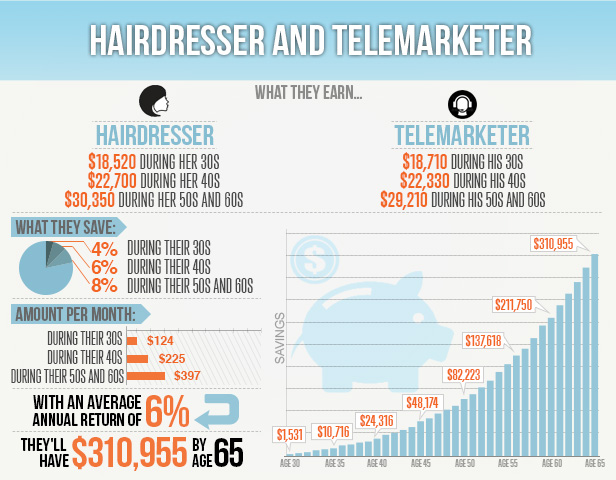
See below for how someone who works as a telemarketer or hairdresser and makes low to average salary (taken from the Bureau of Labor Statistics) will still make crazy money with a Roth IRA:


ROTH IRA earnings

ROTH IRA’s give back mucho earnings even for low contributions, especially when you START EARLY

3. Pay off your debt as fast as you can

This is something I already knew half of. I knew the ‘pay off your debt’ part… but once I realized the benefits of really “getting angry” (a Dave Ramsey term) at my debt and putting all my efforts into killing off my student loans, I really started to make some progress. If you have credit card debt, concentrate on paying off whatever the highest interest card is first (after, of course, paying minimums on all other debt).

If you have debt (except for mortgage debt, which is different), DON’T JUST PAY THE MINIMUM and try not to stop paying! Interest will put you into a hole you don’t want to be in, so don’t let it gather. I had one student loan that was 14,000 dollars originally. I got it down to 11,000 over a period of several years by just paying the minimum. Then I put the loan into deferment (where you can legally stop paying for a time but interest still accrues) for just one year, and the loan went BACK UP to 14,000! Interest is a dangerous game when it comes to debt. So make paying off your debt a huge priority and don’t just let it sit around.

4. If you have a child, consider opening up a 529 Plan for their college savings

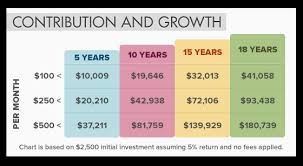
I don’t have a child yet, but I know how hard it’s been to pay off my own college tuition. I sure wouldn’t want anyone else to struggle with student loans when there are better solutions. The 529 Plan is a way to use interest to your advantage by starting a special savings account for your child’s college education. Your money will grow into exponentially more than you contributed originally. It’s best to start very early with this- right when your child is born. See below for how much 529 contributions can grow when starting early.

download

529 plan growth based o contribution and period of TIME

5. It’s never too late!!

Please don’t feel down if you’re behind on these steps. If you have only some or none of these things started, it’s still okay! Start now! You have plenty of time for your money to grow. Even if you’re reading this in your 60s, its not too late! Every step helps, and it’s amazing what you can do if you just make your finances a priority!

Please feel free to comment with any questions or savings/debt anecdotes. I’m still learning about all of this myself, so I’d love to hear from you. I’ve made tons of progress in a year just by incorporating these steps (except the last one) into my life, so I hope this is helpful!

Share this:

  • Click to email a link to a friend (Opens in new window) Email
  • Click to share on Facebook (Opens in new window) Facebook
  • Click to share on X (Opens in new window) X
  • Click to share on Pinterest (Opens in new window) Pinterest
  • Click to share on LinkedIn (Opens in new window) LinkedIn
  • Click to print (Opens in new window) Print
Like Loading...

Help! I’m 30 and still have undergrad student loans from 10+ years ago!

October 13, 2014 By laurasomewherelse in Money Tags: Debt, Retirement Account, Savings Account, Student loan 5 Comments
Help! I’m 30 and still have undergrad student loans from 10+ years ago!

I want to talk about student loans…especially old ones that never seem to go away. Especially those old ones still hanging around from undergrad even after the age of 30. Or 40.

The whole student loan issue may be totally irrelevant to you or it may hit way too close to home, but what’s scary is that these behemoths of debt depend on a decision you made when you were 17. That’s really rough- especially when you think about how young 17 year olds look to you now- isn’t it incredible how short and little high school seniors are? Even a lot of college students seem small and young. Didn’t you feel so big and grown up when you were that age?

I’m one of those people who finished undergrad with an over $100,000 student loan. That’s a lot of money. It hurts to even think about that amount of debt. Especially when I’m already 30 years old and the loan is still around. It means that I’ve lived in the grip of student debt prison for almost 10 years, even as the amount I owe slowly dwindles.

My loan wasn’t for Pharmacy School or Law School or Med School or anything where there was the possibility of a laid out track to recovering my money. My loan was for a drama degree. I remember graduating school and saying to the head of the drama department, “I don’t know what to do now. I have no idea where to go from here.’ And she said to me, ‘Yep. That’s tough.’

It wasn’t exactly a comforting moment.

Since then, I’ve worked on many artistic projects and had many jobs that I’ve loved. I’ve grown, I’ve changed, and I’ve conquered many obstacles in life. But there’s always still been the obstacle of my loan hanging over my head, going down way too slowly and never seeming to disappear.

The loan is such a big part of my world that I sometimes feel like I’m reliant upon it; it drives me forward at the same time that it fences me in. When I’m not sure if I should take a job, or work a certain day, I think: “This money will go toward the death of my student loan. Die loan, die!!” And then I take the job with a smile. But sometimes I want to take a trip somewhere and I think “Nooo..that’s money that won’t go towards killing my student loan. Die loan, die!!” And then I don’t take the trip.

I dream about what I’ll do with all the money I have once the loan is gone. My heart races happily at the thought of finally funding my Roth IRA to the max, hitting my 8 month savings goal, and opening up an investment account. I geek out giddily to investopedia.com and every book Suze Orman ever wrote.

My challenge (and my gift) is that my loan has made me into such a frugal money saver that once I finally conquer the loan, I may be too scared to spend any of my money. I just won’t know what to do with it besides hold on to it- I’ll just want to save it and save it forever. I can imagine cashing it out all in ones (or hopefully hundreds) and jumping into a big pile of it like Scrooge McDuck. And then locking it away again.

Hopefully one day soon, this student loan part of my life will come to an end. I don’t know who I’ll be then, but I know that at least now I’ve begun my journey towards financial wisdom. I’m excited for the day the loan finally dwindles down to a big fat zero; a day when more than half of what I earn won’t go towards paying off this ridiculously expensive thing I bought over 10 years ago.

image (2)

The beginning of my Scrooge McDuck money pile…I’m ready for it to grow so I can jump…

Share this:

  • Click to email a link to a friend (Opens in new window) Email
  • Click to share on Facebook (Opens in new window) Facebook
  • Click to share on X (Opens in new window) X
  • Click to share on Pinterest (Opens in new window) Pinterest
  • Click to share on LinkedIn (Opens in new window) LinkedIn
  • Click to print (Opens in new window) Print
Like Loading...

Post navigation

Start here: Enter your email address to receive new posts quickly and easily by email!

Follow OMG I'm Thirty on WordPress.com

Search For Anything!

Archives

  • December 2018 (2)
  • November 2018 (1)
  • October 2018 (2)
  • September 2018 (1)
  • August 2018 (3)
  • July 2018 (1)
  • June 2018 (2)
  • January 2018 (2)
  • December 2017 (2)
  • November 2017 (3)
  • October 2017 (4)
  • September 2017 (4)
  • August 2017 (4)
  • July 2017 (4)
  • June 2017 (4)
  • May 2017 (5)
  • April 2017 (3)
  • March 2017 (8)
  • February 2017 (4)
  • January 2017 (4)
  • December 2016 (5)
  • November 2016 (5)
  • October 2016 (7)
  • September 2016 (7)
  • August 2016 (11)
  • July 2016 (13)
  • June 2016 (5)
  • May 2016 (6)
  • April 2016 (5)
  • March 2016 (7)
  • February 2016 (9)
  • January 2016 (10)
  • December 2015 (12)
  • November 2015 (10)
  • October 2015 (16)
  • September 2015 (13)
  • August 2015 (17)
  • July 2015 (17)
  • June 2015 (21)
  • May 2015 (22)
  • April 2015 (23)
  • March 2015 (26)
  • February 2015 (25)
  • January 2015 (26)
  • December 2014 (26)
  • November 2014 (30)
  • October 2014 (29)

  • janersays's avatar
  • laurasomewherelse's avatar

Recent Posts

  • So I Paid Off My Student Loans- Part 2
  • Congratulations, Jane!
  • Observations From a ‘Pre-Mom’ at 38 Weeks Pregnant
  • Exactly How to Open Up a Roth IRA in your Thirties (Or any time! It’s never too late…or too early!)
  • Are You Habitually Upset In Your Thirties?
  • So I Paid Off My Student Loans- Part 1
  • Our New Video Series!
  • The Road Through in Your Thirties
  • What Happens In Summer
  • The Loneliness of Being An Expectant Mom

Categories

  • Career (74)
  • children (6)
  • Family (17)
  • Friendships (85)
  • Grab Bag (204)
  • Health and Wellness (90)
  • Money (69)
  • Personal Growth (15)
  • Relationships (54)
  • Spirituality (4)
  • travel (5)

Top Posts & Pages

  • 30 Quotes About the 30's!
  • Have You Found Yourself Not Going Out Much After You Turned 30?
  • The Numerology of Thirty
  • Being Single on Valentines Day in Your Thirties
  • Am I Liable if I Marry Into Debt?
  • 401K, Roth IRA, Retirement Accounts, Oh My! Should I Save in My Thirties?
  • How To Be a Good Houseguest
  • Happy Birthday OMG I'm Thirty! And thank you to our amazing readers!!
  • Origin of the Expression "Dirty Thirty"
  • Happy 34th Birthday, Jane!!! (And All About the Magical Number 34)

Contact Us

omgimthirty@gmail.com

Archives

  • December 2018
  • November 2018
  • October 2018
  • September 2018
  • August 2018
  • July 2018
  • June 2018
  • January 2018
  • December 2017
  • November 2017
  • October 2017
  • September 2017
  • August 2017
  • July 2017
  • June 2017
  • May 2017
  • April 2017
  • March 2017
  • February 2017
  • January 2017
  • December 2016
  • November 2016
  • October 2016
  • September 2016
  • August 2016
  • July 2016
  • June 2016
  • May 2016
  • April 2016
  • March 2016
  • February 2016
  • January 2016
  • December 2015
  • November 2015
  • October 2015
  • September 2015
  • August 2015
  • July 2015
  • June 2015
  • May 2015
  • April 2015
  • March 2015
  • February 2015
  • January 2015
  • December 2014
  • November 2014
  • October 2014

Enter your email address to subscribe to this blog and receive notifications of new posts by email.

Join 256 other subscribers

OMG I'm Thirty

Footer menu

  • Home
  • About Us
  • Career
  • Friendships
  • Health and Wellness
  • Money
  • Relationships
  • Grab Bag
  • Spirituality
  • Travel
  • 30 Quotes About the Thirties Book!
Create a free website or blog at WordPress.com.
↑
Privacy & Cookies: This site uses cookies. By continuing to use this website, you agree to their use.
To find out more, including how to control cookies, see here: Cookie Policy
  • Subscribe Subscribed
    • OMG I'm Thirty
    • Join 256 other subscribers
    • Already have a WordPress.com account? Log in now.
    • OMG I'm Thirty
    • Subscribe Subscribed
    • Sign up
    • Log in
    • Report this content
    • View site in Reader
    • Manage subscriptions
    • Collapse this bar
 

Loading Comments...
 

    %d