Do you have a mission statement?

Last night I was down in the dumps, feeling lost and somewhat aimless in my life. A lot of this feeling comes from being in graduate school, in a program where I’m often home alone, writing, trying to will my imagination to work with me, damnit. You would think graduate school would actually provide me with MORE of a sense of focus, but alas, that has not been the case.

I could write with other people, or go to different locations, but I find my best work is done solo in a quiet space. (I might have to re-evaluate this theory soon). When I’m in my own head too long, I tend to go a little stir crazy, but when I have too much social interaction, I also go crazy. It’s all about keeping a fine balance between nurturing my introversion and extroversion.

Back to last night. I poured myself a glass of wine and got into some google searching. I think I started with “thirty something feeling lost,” and found some interesting articles. As long as you don’t go down a crazy rabbit hole time-suck, I highly recommend googling your feelings to make yourself feel less alone.

One of the articles I stumbled upon was about crafting a life mission statement. The kind of mission statement the writer is talking about isn’t the one at the top of your resume, or your LinkedIn profile. This is your personal life mission statement, perhaps oriented around your values or how you want to spend your time.

Here are two anonymous examples I found on franklincovey.com. (This company is a business oriented leadership site, but they had some great examples of personal mission statements.)

“My mission is to give, for giving is what I do best and I can learn to do better.
I will seek to learn, for learning is the basis for growth, and growing is the key to living. I will seek first to understand, for understanding is the key to finding value, and value is the basis for respect, decisions, and action. This should be my first act with my wife, my family, and my business.
I want to help influence the future development of people and organizations. I want to teach my children and others to love and laugh, to learn and grow beyond their current bounds. I will build personal, business, and civic relationships by giving, in frequent little ways.”

I loved this one:

“I want to be the kind of person my dog already thinks I am.”

Do you have a mission statement?

I don’t have one now, but I’m going to craft one soon. Maybe it could help alleviate that ‘lost’ feeling.


Restarting In Your Thirties

Has your computer ever stopped working? Perhaps it completely froze up after you tried to download something, or the timer kept spinning when you attempted to install a new operating system? Were there times when you couldn’t fix the problem? Did you have the urge to take the whole beautiful machine and just throw it on the floor?

Last week I was working at an event in New Orleans where all technology kept breaking down. We had an Apple TV, various iPads, spotty wifi, scanners, lots of sound equipment, HDMI cables, bluetooth, and more all used in our multiple presentations throughout the day. Various times, after troubleshooting a problem for awhile ourselves, we’d break down and have a tech person come over and look at things. More often than not, the solution ended up being:

1. Hold down button to force close device.

2. Count to ten.

3. Push button again to turn on device.

That was it. Then it would be smooth sailing once again. I’d say about 70% of the time, that was all it took. After catching on to this deceptively simple trick, I was troubleshooting issues like a pro, and we had a lot less need for tech support. Strangely enough, people kept commenting on how tech savvy I was, even when I explained the solution to them. 70% of the time, it’s such a simple answer!!

When I got back to New York after the event two days ago, I was exhausted. However, I went to bed really late and didn’t get enough sleep, so I was even more tired yesterday. Still, I put some major items on my to do list for the day. Since I finally had a day off, I was going to attack the list, which included ‘write 3 articles, meditate, switch summer/winter clothes, clean out closet, go for 7 mile run, cook lunches for the week, unpack suitcases and do laundry, clean out email inbox, return all emails. These items seemed pretty basic to me, and I was sure I could get them done in a day. But instead of doing any of them, I forced myself out of bed and wandered my apartment like a maniac, sitting down to meditate and then getting up immediately. I turning on the stove and then turned it off. Sat down, got up, opened the laptop, closed it again. Turned on the shower faucet, turned it off. I couldn’t concentrate. I felt jittery and anxious. An hour or two went by and nothing got accomplished. I berated myself for wasting precious time and made myself even more anxious.

Then I remembered all the ‘broken’ technology this weekend. I felt broken.

And then I thought about my solution. It had worked 70% of the time before: Turn it off. Wait. Turn it back on.

I scrapped my to do list. I lay in bed. I stared at the wall.

Then I opened to a blank page and wrote:

1. Shower

2. Meditate

3. Take care of self.

4. Enjoy day.

I stared at the paper. “I can do this.” It was actually still difficult. I found it hard to move, but eventually I dragged myself into the shower.

With that simple action, I started to move forward, and afterwards I turned on my meditation music and stayed seated. When I finished, I stared at the ceiling again for awhile. Then I watched a show on Netflix. Then I went and met a friend for dinner. I listened to podcasts on the subway. My shoulders slowly unclenched. Then I slept for almost 12 hours last night… I must’ve been pretty tired.

Today I feel slightly better than yesterday, although I’m still prioritizing a careful need for rest. And for time.

Sometimes solutions are as simple as turning off and turning back on again. Meanwhile, let yourself enjoy the off moments in between. Sometimes you just need to restart. Try it for yourself- it seems to work 70 percent of the time.


Tracking and Hacking Your Health

Today I impulse bought a Jawbone Up Fitness tracker. I guess it’s unfair to say the purchase was impulsive, because I’ve been thinking about it for a long time, but I’d held off because I assumed I’d use the new iPhone to track my steps, once I bought it that is. But the iPhone is just too expensive for me at the moment ($370, gasp!), so this was a in-between purchase. The Jawbone Up was on sale at Best Buy for $64.99. Not too bad.

You wear the Jawbone around your wrist, and it tracks the amount of steps you take and the amount and quality (deep vs. light) of sleep you’re getting. I’ve always liked the idea of collecting data about yourself and trying to “hack” your health to make yourself healthier and happier.

As I’ve gotten into my thirties, I’ve noticed that my body isn’t functioning the way it used to. And not only my metabolism – which is the change every thirty-something seems to mention when it comes to changing health. For me, my body seems to be having trouble digesting the food I used to love, namely carbohydrates. I think it might be a gluten intolerance, so I’m ‘hacking’ my body by trying a 21-day no-gluten diet.

So, I like the idea of the Jawbone because it’s a way to track and monitor your habits, and I hope that it helps me develop better ones.

Have you ever used one of these devices? What did you think?

Photo on 11-9-14 at 5.19 PM

I’ll keep you posted on how it goes.

Consciously Removing Unconscious Labels

New Orleans is one of my favorite cities in the country. However, I’ve been here before. Numerous times. And so I’ve found it hard to care as much as I used to.

When I arrived in New Orleans for work two days ago, a dull happiness beat in my heart. But then that happiness was quickly covered by a grayness. For me, this grayness is common…it occurs when I find it hard to feel.

I remember the first time I ever came to New Orleans- about two years ago. I was so excited. I took a Mardi Gras Tour, a Walking Tour and a Ghost Tour. I wanted to do it all- even though I was working. I ran along the Mississippi River before work. I ate beignets for dessert. I took pictures of balconies at dusk. I daydreamed about Tennessee Williams plays and listened to jazz. Voodoo stirred my soul. Everything was so unique.

This time, because of all the other times I’d been here before, my mind duly noted that New Orleans was one of my favorite cities. My eyes glossed around town. I’d seen it. I felt anxious. I felt nothing much. New Orleans had become a label.

I wouldn’t even have registered this, except that the other day a guided meditation I was listening to talked about how labeling things had become the norm for almost everyone. At first I thought ‘absolutely not me!’ and then I realized labeling is actually my unconscious’ favorite thing to do. Labeling orders my world and keeps everything recognizable, safe and easy. Does this sound familiar to you? You put things and people into a box and label it with an opinion, and then you just look at the label to know what’s inside. It’s hard to really see things again after that.

I know academically that even when you see the same thing 100 different times, it’s never the same. But it’s so hard to actually grasp the meaning of that in real life. So hard.

So yesterday I decided to fight the labels. I was going to look again. I was going to see New Orleans uniquely once more. I was going to move past the grayness and feel something new while seeing something old.

So I stared down the alleyways..the ones I used to thrill at seeing in NOLA, but now passed by. They led to their usual gorgeous open courtyards.

photo 3 (2)

And again I saw the funny gates that led to nowhere. A gate guarding a brick wall.

NOLA Gate

And I once again saw a city maybe falling apart. And a city with bizarre examples of its slow ruin scattered everywhere.

Stuff started to pop out at me that I hadn’t exactly seen before.

photo 3 (1)

And the grayness lifted for a second as I became curious. So I just kept on looking.

I realized it was the first time I’d been here in November. And I saw leftover Halloween decorations.

photo 2 (1)

And places that had never needed Halloween decorations. photo 5

And places that had funny signs.

photo 1 (2)

And places that were just paint.

Photo (4)

And I followed the sound of some church bells and stumbled onto a glass blowing school by accident.

photo 4 (1)

So I went inside and sat and watched glowing hot glass become birds and pumpkins…glass shaping itself from nothing to something right in front of me. I hadn’t seen glass blowing live since I’d been to Venice many years ago…and I’d always found it to be an unbelievably neat process. It still fascinates me.

And for a moment I felt happy.

photo 5 (1)

photo 2 (2)


And as I sat and watched liquids become solids I had to admit to myself that my New Orleans labels weren’t gone- they weren’t that easy to remove. But yesterday, through sheer will, I had set them aside for a second, and for a moment the grayness had lightened.

Ultimately, I couldn’t summon up the same amazing feelings as the first few times I’d been to New Orleans. I didn’t suddenly jump for joy. I didn’t burst into tears. I didn’t have a sudden revelation. But it was okay.

I felt…a much more subtle movement inside. Something raw. Something clear. Something new.


Bad Mood Relief with Meditation and Therapy

While I love winters for the hot toddies and for having a legit excuse to wear tights and chunky sweaters (and mind you, I still do this in LA!)  it does mean our days are getting darker earlier and we’re getting less sunlight. Our bodies begin to lack that essential mood boosting Vitamin D. I’ve been fighting the blues this past year, on and off, so I can’t say it’s a “winter” thing or SAD (Seasonal Affective Disorder). Most of my blues is from the ongoing transition from moving from NYC to LA, and grad school stress. While my favorite self-soothing remedies help (a glass of wine, pizza, and an episode of Parenthood. Clearly, I’m also a cheap date) temporarily, I’ve found some lasting change in two practices. Meditation and Therapy. I’d like to tell you a little more about how they worked for me.

Meditation 

Have you tried meditation? I’ve always wanted to, and have some meditations sporadically over the years, but I’ve only recently gotten more serious about keeping the habit.

There are lots of ways to do it. You can simply sit still and concentrate on your breathing for a specified amount of time, 5-20 minutes generally. Or you can try a guided meditation using links online. I know Laura likes using guided meditations, and I find them useful too. I’ve found that when I have nothing to listen to, it’s so hard to sit still for more than 5 solid minutes.

Right now, I’m participating in the Oprah and Deepak Chopra “The Energy of Attraction” 21-day challenge. There’s still time to sign up. It’s a free series of 20 minute meditations for 21 days Check it out here. https://chopracentermeditation.com/about-us

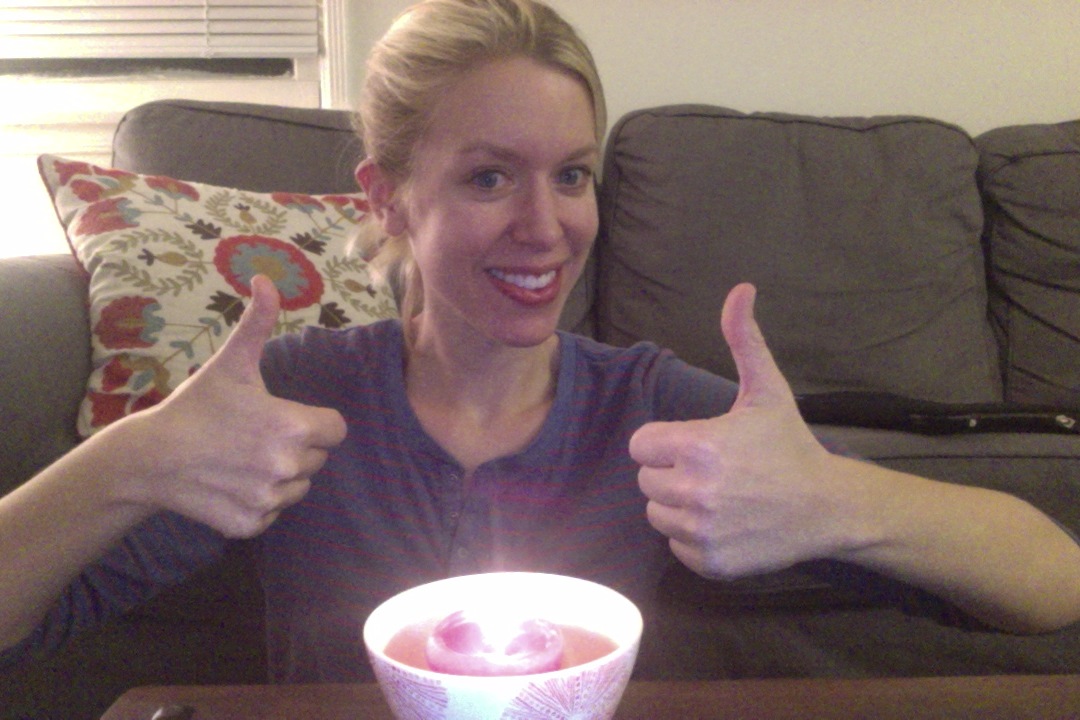
I put a little candle on and let Deepak and Oprah do the work.

Meditating

Post meditating

There are also specific types of meditation. Two years ago, my friend and I checked into Transcendental Meditation, which lots of people SWEAR by, but despite the organization being a non-profit, there’s a steep fee for the introductory course, which I think is about $750. There’s a 50% discount for students, and I considered doing it in LA, but ended up deciding to wait until I had some more funds. We enjoyed the free Q and A we attended, and I really believe they are doing great work but damn if I can’t see paying that much for meditation. The thing that makes TM meditation somewhat different is that you’re assigned a mantra. (Always reminds me of Annie Hall, “Help! I’ve lost my Mantra.”)

Therapy 

I’m a therapy evangelist! I went for the first time about 6 years ago when I was going through a bad breakup. It was very helpful, especially when my therapist had me join a group session for people going through breakups. It was such a relief to talk to people going through the same thing. Luckily, it was covered by my health insurance with a co-pay. I think the co-pay was quite high, something like $40, but it still felt like a good deal at the time.

Now I’m in therapy once-a-week for regular talking sessions. Normally I just talk about the week and how it’s going. There’s no agenda, other than to release my thoughts. I’ve noticed that every time I leave therapy, I start yawning like a mad person on the bus ride home. Once I noticed this pattern, I realized how much I was holding in during the week, and how relaxing it was to get my mind unburdened.

Think money is an issue? Or do you not have health insurance? Sliding scale therapy is offered by a lot of psychological training programs. That’s what I do, and it’s based on what I can pay according to my salary. Since I’m in grad school and only work part-time, it was agreed upon that I pay $20 a session. That’s not bad at all! My therapist is technically a recent grad, but he’s pretty damn good.

And, ultimately, with therapists, it’s ALL about the fit. You have to feel like your therapist is right for you. Don’t be afraid to choose another therapist. It’s all about finding the right fit and approach.

So those are just two of my favorite healing techniques. But with both of them, the results are subtle and incremental over time. And yeah,  some days, the best therapy is a glass of wine and a good phone chat with an old friend.

So You Want to Get Plastic Surgery

Renee Zellweger has been all over the news recently regarding her facial transformation. This news is so ubiquitous that it twice has made it onto a daily ‘top ten world news items’ email that I subscribe to.

Her new image caused me to do several double takes. I searched her name on Google in order to see even more unrecognizable photos. And I must admit my first few thoughts surfaced quickly: I judged her. Harshly.

‘What has she done to her face?’ I thought to myself. “It’s horrible that I can’t recognize her anymore! WHY would she do that?”

And then the opinion pages popped up all over the internet:

“She shouldn’t have done that to herself- she should be natural!!”
“Goddammit! Why?? She looks totally different! I liked her old face!!”
“The horror!! She looks even older now!”

And like a rapidly dividing cellular organism, the opinionated groups split and split into voices screaming everywhere:

“Be natural,” “Looks like an ENTIRELY DIFFERENT PERSON,” “Trying to look younger,” “Horrifying” “Don’t talk about it anymore!”

But we’re talking about it. Even when we shut up, we’re thinking about it. It’s part of our culture to judge and put beauty and the act of aging under a microscope. Celebrities are under the microscope more than non-celebs, but only because they have more photos/video taken of them, and are seen by more people. Aging is judged for us all, and so people who try to combat aging are judged and reviewed even more. And this media frenzy has happened right now because Renee Zellweger seems to have “failed” the aging test.

In our society, women aren’t supposed to look like they’ve aged if they want to be valued; so the question strangles us from a young age: how do we stop letting age show on our faces and bodies? How do we pass the aging test? Can we eat perfectly “clean” and follow the ‘right’ exercise and sleep routines and be balanced and meditate and never stress out? Can we ‘make up for aging’ in some other way, by perhaps excelling with our creative talent (the Meryl Streep argument), utilizing our outstanding intellect, accomplishing our inner goals and dreams? Will these things make us better?

Maybe they will and maybe they won’t, but the purpose of all the above achievements and routines was never to make us LOOK better, but to make us BE better.

Becoming a better person inside doesn’t always show physically. It seems fair that inner beauty will always shine through on the outside, but life isn’t fair- when did we ever think it was? It is 100% certain that we will all age. There will be people who naturally look younger when they are older- a combination of luck and some habits and genes. Then there will be people who look their age or older- also a combination of luck and some habits and genes.

If successfully ’passing’ the aging test means looking looking naturally younger or “natural but still very good” then you will have ‘passed’ if you luck out by aging well ‘naturally.’ If you don’t feel like you have aged well naturally, then you’re stuck being judged for ‘looking old.’ So you can try to fix this with plastic surgery, Botox, or other outside help- but you will only have succeeded if the ‘help’ is a secret..if it’s completely and mysteriously invisible.

So the ‘aging test’ goes into super difficult bonus round challenge if you reveal the secret…you’re not allowed to show that you’ve had-gasp!- surgery! You can’t show that you’re trying to beat the system ‘unnaturally’– that’s cheating!

What’s that? Did I just write that we’re set up to fail?

I think so. The system that’s in place is set up to be all but impossible to beat. It’s a system of hypocrisy and double standards, of secrecy and judgement. The only way to beat it now is to join it, to believe in it or live in shame. And that’s not really beating it at all.

Our system is broken. It’s NATURAL to AGE! It’s Natural that age shows on our faces and bodies. But what our culture wants is a youthful look at all costs. So let us not judge plastic surgery. Let us judge our culture.

The Grass is Greener Syndrome

Everything in your life could be better, if only got a new job, moved, owned a dog, ate five servings of vegetables a day, gave up alcohol, ate gluten free, and the list goes on…

Since I graduated college in 2004, I’ve moved to a new apartment every year with the exception of two years. When lease renewal time came around, I always felt I could find a better apartment, a better “fit” for me, or a more fulfilling roommate situation. (In fact, as I’m writing this, I’m thinking about how great a new, bigger apartment would be, despite having just moved three months ago.) Besides all the money I spent on moving costs, there was the psychological toll of moving. Moving can be traumatic and stressful. Every year, I’d lug all my belongings from one Brooklyn neighborhood to another, until I had exhausted all the neighborhoods and at last, borough-hopped to Queens.

Recently, I realized that maybe this was some pattern and indicative of something deeper. And apparently, there’s even a term for this chronic need to find the next best thing. It’s called “the grass is always greener syndrome” or GIGS for short.

This syndrome, “the grass is greener” dilemma,  is not just limited to moving. It can affect all areas of your life. Ever known a chronic job hopper? Or someone who’s always “falling in love” with someone new? I’m not judging this behavior, and in fact, having a desire to improve your life is natural and evolutionarily adaptive. But it gets self-destructive when it infuses everything else in your life with doubt. How can you enjoy a relationship, friendships, a job when you’ve got a nagging feeling that it could be better?

When I moved to LA a year ago, I had all these grand hopes for changing my life. I imagined I’d be more relaxed, eating avocados, walking on the beach, and writing my screenplays all day long…Uh. Yeah, right. As much as I tried to leave my issues in NYC,  I they joined me in California. I still have trouble motivating myself to write for long stretches of time, I still don’t exercise as much as I should, and more often than not, I opt for Trader Joe’s frozen meals over fresh avocados.

But I guess what I am trying to learn and internalize is that there’s great pleasure to be gained in loving a place, a person, a situation for a long period of time. Finding ways to improve upon something and being at peace with “what is.” (This is new-agey Jane coming out now.)

There’s an Eckhart Tolle quote that really speaks to this:

“Whatever the present moment contains, accept it as if you had chosen it.” – Eckhart Tolle


Egg Freezing Procedure Covered by Employers Apple and Facebook

You’ve probably heard the news that Facebook and Apple are now offering to pay for an egg freezing procedure for their female employees. Essentially, this policy was put in place to help women free up time to focus on their careers… without the stress of declining fertility and the pressure to have a child stat. You can read more details about their new free egg freezing policies in Bloomberg Business Week’s thorough article: Later, Baby: Will Freezing Your Eggs Free Your Career?

The procedure costs anywhere from $7,000 to $12,000 plus storage fees, which run about $1,000 yearly. The majority of insurers do not cover this procedure.

I’m all for women having flexibility and choice when it comes to deciding when to have children. As someone who’s nearly 33 years old, I know firsthand the stress of wanting to have children but also wanting to get further in my career; It feels like this heavy invisible weight I carry around, knowing I have to make this very important decision soon. For me, egg freezing is not an option, mainly because I don’t have $10,000 to spare. If it were free, I would probably get my eggs frozen. So I’m thrilled that companies like Apple and Facebook are paying for their employees to have extended time to make what is likely the most important decision of their lives.

That said, I’m unsettled thinking that only these elite Silicon Valley companies are offering this ‘perk’- (I have about a .01% hope that bigger, more ‘corporate’ companies will offer this anytime in the next five years). These large companies are the same ones that offer perks like free candy bars with frozen yogurt/ unlimited sweet goodies (Facebook), on-site barber shops (Facebook), Shuttle bus services (Apple), and many more freebies I can only dream of.

The idealist in me wants every woman to have an egg-freezing option, not only women that can afford it, or women that work for one-of-a-kind silicon valley companies who *may* be offering this as a general PR play or HR recruiting tactic.

The Gift of Living to Thirty

What if you knew you weren’t going to make it to age 30? What would you do? Doctors recently told 29 year old Brittany Maynard that she had a rare tumor in her brain that would stop her from living to celebrate her 30th birthday. Brittany decided to take matters into her own hands.

When Brittany learned that she had stage IV glioblastoma multiforme- a rare type of brain cancer that would kill her in a matter of months, she was living in California, but she and her husband decided to move to Oregon after the diagnosis. This is because Oregon is one of a handful of states that upholds what’s known as the Death With Dignity Act. This act provides options for dying individuals to choose when and how they would like to end their life, helping ensure that their final time on earth will be filled with as little pain and suffering as possible.

Brittany told People magazine, “My glioblastoma is going to kill me, and that’s out of my control. I’ve discussed with many experts how I would die from it, and it’s a terrible, terrible way to die. Being able to choose to go with dignity is less terrifying.”

Brittany has chosen to end her life on November 1st, in order to spend October 30th with her husband on his birthday. She will take prescription medication in her own room surrounded by her closest family and best friend. “Now that I’ve had the prescription filled and it’s in my possession, I have experienced a tremendous sense of relief,” Brittany said. “And if I decide to change my mind about taking the medication, I will not take it. Having this choice at the end of my life has become incredibly important. It has given me a sense of peace during a tumultuous time that otherwise would be dominated by fear, uncertainty and pain.”

Though the Death With Dignity Act has become more accepted in recent years, and has been adopted in Washington, Vermont, Montana, and New Mexico, there is still some pushback against it. People are saying that a terminally ill patient choosing to end their life early is still committing suicide calling and calling the Death With Dignity act ‘assisted suicide’ and ‘euthanasia.’ Brittany has said this in response: “There is not a cell in my body that is suicidal or that wants to die. I want to live. I wish there was a cure for my disease but there’s not.”

I’d never heard of Death With Dignity or glioblastoma multiforme before Brittany’s story. I’m glad that she’s able to end her life on her terms and not completely at the mercy of her disease. My heart breaks for this brave, beautiful woman who will not live to see age 30.

Watch Brittany’s amazing video here.

You can join me in signing a thank you card to Brittany. Her story of courage at the end of life has become an inspiration to millions of people around the world.

66bcf999c0470eefdca910e265dfab1e41b37764

A “Thrisis” Is Not A Medical Condition

Ever heard of the word “thrisis”? I hadn’t until the other day, when a wine-fueled googling expedition led me down a rabbit hole of articles about “surviving your thrisis.” It sounded like some strange medical condition, something in between thrush (yikes!) and a thyroid issue. But the word “thrisis” actually refers to the mental and psychological “crisis” that one experiences during their thirties, not unlike a mid-life crisis.

I’m not sure where the term began or who exactly coined it, but it’s been popping up in articles and blogs. While everyone seems to have some different version of it, the common themes and complaints of a “thrisis” seem to be:

  • “Now that I’m 34, my life doesn’t match up with how I thought it would be.”
  • “I’m a corporate professional and I’ve reached a high-level in my company and have a corresponding salary, but how come I don’t feel fulfilled?”
  • Basic feeling of being underwhelmed with your life
  • Feeling less “black and white” about life and choices, and more “grey”

There’s even a book about having a “thrisis” – it’s called “30-Something and Over It” by Kasey Edwards.

In her book, Edwards talks about how the experience of having a “thrisis” can help you “take stock” of your life so you can avoid having regrets down the road. She writes, “It’s about looking ahead, thinking, I don’t want the next 30 years to be like this.”

I’ve definitely thought about this in terms of my own life, and yes, I do have occasional freak outs about feeling “behind” as a thirty-something. I don’t have a solid set of career accomplishments, I’m not married, and I don’t have children. But since I’m still climbing the ladder towards my career as a screenwriter and TV writer, the common ‘thrisis’ feeling of reaching a high level and not finding fulfillment isn’t resonant for me.

How about you? Have you had a “thrisis”?