Are There New Feelings In Your Thirties?

Do you ever feel like you’ve experienced the full spectrum of your feelings by the time you’re in your thirties?

You may not know how you’re going to feel in every scenario, but when a feeling arises, you’ve probably felt it before. After all, once you’re in your thirties, you start recognizing different versions of the same scenarios repeating again and again…so you start to get familiar with the feelings that come up again and again…like a familiar mix and match.

I never consciously felt like I’d experienced the full gamut of my feelings, but unconsciously, I thought that there were no new feelings under the sun for me.

Then today a wonderful and very exciting thing happened and I sort of couldn’t believe it. Afterwards, I almost went into shock. I felt all tingly and almost exhausted, but also sort of glowing and dreamy and unreal. It was a new feeling, which I dubbed ‘happy shock.’ I didn’t remember feeling it before. I knew ‘bad, unhappy shock’ or just plain ‘shock’ but ‘happy shock’ was a new one. And it was really exciting.

Later, I saw a play that a friend of mine wrote. It was extremely sad, and I couldn’t stop crying throughout most of it. Usually, even when plays are sad, it’s very rare that I cry and feel so connected to and affected by what’s happening. The play was extremely well-written, so that was definitely a part of it, but I think the new ‘happy shock’ feeling earlier just opened me up to my emotions in general. Perhaps one new feeling can start a bunch more.

Do you ever experience feelings you’ve never had before? Are there multiple ones yet to discover?

“Having It All” – The Secret to Work/Life Balance

There was a big uproar this week after this New York Times article was published, How Some Men Fake An 80 Hour Workweek, and Why It Matters. It’s a fascinating look into how men and women with high-powered, demanding jobs manage to also make time for family and still get promotions and raises. The article cited a study at a top tier collar consulting firm that showed that many of the professionals claiming to work 80-90 hours a week weren’t actually working that much, and also highlighted that many of these “fakers” were men.

The article dives deeper and talks about how many of these high-powered women would ask for maternity leave or flexible schedules to spend more time with their children, BUT by asking for this time, they were ‘punished’ come their performance reviews. They often didn’t receive promotions or raises as readily as men/women who claimed to work the 80-90 hour weeks.

To me, the most fascinating part of the article is that if you don’t explicitly ask for a flexible schedule and simply keep up the appearance of working a ridiculous amount of hours, you are rewarded. The author, Neil Irwin, explains the difference between those who ask for more flexibility at work and those who don’t:

A second finding is that women, particularly those with young children, were much more likely to request greater flexibility through more formal means, such as returning from maternity leave with an explicitly reduced schedule. Men who requested a paternity leave seemed to be punished come review time, and so may have felt more need to take time to spend with their families through those unofficial methods.

The result of this is easy to see: Those specifically requesting a lighter workload, who were disproportionately women, suffered in their performance reviews; those who took a lighter workload more discreetly didn’t suffer. The maxim of “ask forgiveness, not permission” seemed to apply.

Basically, the key takeaway is that you shouldn’t call attention to yourself if you’re going to ask for time off or a flexible schedule. Having worked at a few major corporations myself, I definitely believe there’s a lot of truth to this. Unwavering devotion to your job and the perception that you put your job above all else in your life seems to go a long way towards making you successful.

What do you think? Would you rather ask your boss for a flexible schedule/lighter work load or “keep up appearances” of maintaining your same pace/productivity?

How Much Should I Be Contributing to My Retirement Account in My Thirties?

The Suze Orman Show recently went off the air and I’ve been heartbroken ever since.

I never watched Suze on tv, but I listened to her show religiously, podcast-style. After all, Suze’s money commentary was addictive, and she dispensed the good advice to give up cable, which I haven’t had in years to begin with.

There are so many points Suze repeated over and over that made simple what used to feel so complicated in the world of money. She kind of changed my life. In tribute to her, my next few money posts will be as short and simple as possible- her best ideas were short and powerful and repeated time and time again.

So here’s how much you should be contributing to your retirement account(s) in your thirties:

1. First, if you are an employee (and not an independent contractor) make sure you are actually signed up to contribute to your work 401k. Are you SURE? I have so many friends who thought they were signed up for years but actually weren’t. So they contributed ZERO…by accident. Double check.

2. Second, if your workplace offers a 401k match, contribute money into your 401k up to the match. Then stop and contribute to your IRA or Roth IRA. 

3. If your workplace doesn’t offer a 401k match, or you’re self-employed, start out by contributing the maximum to your IRA or Roth IRA. Don’t know how to open an IRA? Read about simple ways to do so here.

4. You can contribute up to $5,500 a year to your Roth IRA OR your IRA. Total. Try to hit that mark. If not, do what you can.

5. Contribute what you can to that IRA or Roth IRA. This is your main retirement vehicle. I try to contribute 10% of my income to my Roth IRA. Many financial advisors recommend 15%…I’m not ready for that yet, but once I finish paying off my student loan I will be.

6. If you max out both your 401k MATCH and ALSO your Roth IRA or IRA, then go back to your 401k and contribute as much as you can. You can contribute up to $18,000 in 2015.

7. If you don’t have a 401k because you’re self-employed like me, and you’ve maxed out your Roth IRA or IRA (good for you!), then you can start contributing to special retirement accounts for the self-employed. Learn about those here.

Hope this helps you learn how to save for retirement! Please ask any questions you have- I’m happy to answer or find you answers! 🙂

8a4e85da52d52e6fb07789c721020061

Portrait of a Thirtysomething – Jamie Wiley

We’re thrilled to bring you the third interview in our series, “Portrait of a Thirtysomething.” This time we were lucky enough to get the fabulous Jamie Wiley, of the blog Sincerely, Miss Design, to agree to be interviewed. Jamie’s got an inspiring story that reminds us that you can change the course of your life at any point and that’s it’s never too late for a new path. I also loved what she had to say about toxic relationships…Read on!

Name/Age/Location:  Jamie Wiley, 32, Allentown Pennsylvania

Occupation:  Real Estate Appraisal Coordinator (aka Glorified Secretary) and full time Graphic Design student

wiley_jamie_headshot (1)

What’s the accomplishment you’re most proud of in your 30s so far?

By the time I was 31 I came to the realization that the things I wanted career wise were not just going to fall into my lap. When I graduated college 13 years ago I took a job that I had just planned to work at for a short time to get my bearings and go back to college in a year or two. I just kept pushing returning to school off and there I was 13 years later still working at the same job feeling stagnant. Finally I took control of my life and enrolled in college full time. It’s been incredibly difficult juggling both a career and school work, but so far I’ve been able to maintain a 4.0.

What do you NOT miss about your 20s?

I do not miss the insecurities and uncertainties of that time in my life. Even though you are physically “grown up” in your 20’s, it takes a little while longer for you to mentally catch up. During my 20’s I was still learning what being an adult actually meant. Rather than budgeting my money out between pay weeks I’d spend my whole check the same day I got it. I was so strapped for cash that I’d hunt down every loose coin to take to the Coin-star machine to get cash. Of course the irresponsible spending lead to massive credit card debt that took years to bail myself out of.

Looking back, what shouldn’t you haven’t been afraid of in your 20s?

I should not have been afraid to let go of toxic relationships. I always felt obligated to maintain relationships with family members and friends regardless of the fact that they were dragging me down. I’ve learned that sometimes it is better to part ways with people to maintain your own sanity.

I also should not have been so afraid to stand up for myself and my beliefs. I have always been a passive aggressive people pleaser which basically made me a doormat.

Any surprises about what your 30s are like?

Yes, a few things. As I get older I gain more self confidence and acceptance of myself as I am. I no longer take to heart negative things people may say or think of me. In turn I’ve learned to be less judgmental of others.

What do you find most challenging about this decade?

In your 30’s you have more of a sense of what direction your life is going to go in. So, I think that at this point everyone’s lives branch off into different directions. Friends move, change careers, start families, etc. All of our priorities suddenly change and it takes a great deal of effort to stay in contact with one another.

Also, learning to listen to my body. I can no longer live on junk food and soda. If I do not eat proper meals or drink enough water I feel terrible. I’ve made it a habit to stretch and foam roll every night before bed to maintain flexibility.

What are you most looking forward to? Be it tonight, next month or ten years from now!

I’m looking forward to graduating from college and any great opportunities the future holds for me!

Thanks so much, Jamie! We loved reading your interview. 

Check out her website, Sincerely, Miss Design for more about Jamie.

I’d Give Up Being Happy To Be Happy

Tonight a friend of mine drunkenly called me after hitting up a bar too many (or maybe it was the perfect number of bars).

We were having a pretty funny and awesome one-sided drunk conversation for awhile (I was unfortunately just sitting soberly at my desk), when the tone turned slightly negative. It was a still pretty awesome conversation, the way one sided drunk and negative conversations can often be (admit it), and things were said such as ‘sometimes people can just suck! Why?? Why do they suck??’ Rambling rants commenced.

Then my friend suddenly said “I just want to be happy. I’d give up being happy to be happy.”

I laughed and asked what in the world that meant.

“I don’t know,” was the reply, “I’m drunk. I’m rambling.”

“Haha, I see.”

“But I just want to be happy now. Not just later.”

My friend made an offhand drunk comment, but it got me thinking about long term happiness vs short term happiness- or long term happiness vs short term pleasure.  Right now, I’m kind of down and I just want everything to be okay. When I’m feeling upset,  sometimes I just want the shortest road to feeling better. Even though I know what will lead to happiness in the long term, there are times I just want things to satisfy me now.

Wanting pleasurable experience after pleasurable experience without sacrificing for the long term is called the hedonistic treadmill. Some people spend their whole lives on it. That short term patchwork feel-better “happiness” is actually just pleasure, whereas deeper and true lasting happiness is something far different. A good example is eating platters of nachos on the couch instead of exercising, when your goal is to get fit. The platters of nachos may be delicious and give you short term “happiness” (pleasure), but seeing results from your workout regime would give you way more long term happiness.

Right now I find myself grappling with this a lot, in much less obvious ways than the nacho example. I see the hedonistic treadmill issue pop up when I’d rather stay in a non-ideal situation rather than go through the discomfort of demanding better things in my life. Or when I want to feel peaceful all the time and can’t face occasionally upsetting but natural feelings in order to work through them.

Do you recognize a pleasure-addiction syndrome in your life- even a subtle one? What can you do to better face occasional unpleasantness and sometimes very scary feelings in order to have greater happiness in the long run?

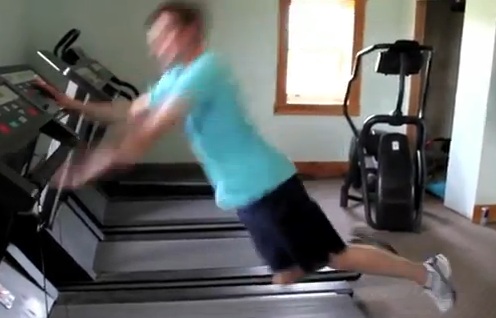
Treadmill-Fails-Compilation

Do You Know About Dunbar’s Number?

I guess friendship has been on my mind lately, considering this is my third consecutive post about friendship. Perhaps it’s the realization that I still feel like an outsider in my new city after a year and a half.

A few years ago, I remember being fascinated by a concept called “Dunbar’s Number.” According to Robin Dunbar, a British Anthropologist, the average human brain can only effectively maintain a social relationship with approximately 150 people at a time. Basically, our brains just don’t have the cognitive capabilities to handle remembering all the details of more than 150 people at one time. According to research, this is evolutionary and has been true since the dawn of man. In hunter-gatherer societies, the average community was about 150 people.

Now this doesn’t mean these people are your actual ‘friends,’ they are simply people in your social circle. If you would stop to say hello to someone on the street, they probably count in your 150.

But what’s a bit scary, at least for me, is that a lot of my closest “150” are scattered around the country. They are not all in my community like they probably were for  those in hunter-gatherer societies. I don’t get the benefits or a reassuring hug or an arm squeeze. So essentially, the benefits of my ‘community’ are diffuse and not as concentrated as they could be.

What does this mean for us, as most of us become increasingly mobile in our lives? Are most of your “150” located near you?